The Biggest Marketing Mistake Small Businesses Make
I once watched a client spend $15,000 on a complex digital advertising campaign to attract new leads. After three months, the campaign had generated exactly zero new customers. Meanwhile, a simple, three-sentence email to a list of 200 past clients landed them a $50,000 project in 48 hours.
This isn't a rare story. It's the reality for most small businesses. You're told to chase new leads and invest in complicated marketing funnels, but the results rarely match the effort. It feels like you're doing all the right things, but something is still missing.
But here's the thing. The reason small businesses struggle with marketing isn't because you need a bigger budget or a more complicated strategy. It's because you've been taught to focus on the wrong goal.
The reality is simple: there is a better, more direct path to growth, and it starts with the people you already know.
Key Insights
Chasing new leads is a losing game. The traditional marketing model is designed to keep you spending money on ads and complex software, a game that is rigged against small businesses.
Your existing contacts are your most valuable asset. The people who already know you are your biggest opportunity for growth. They are a warm audience that is more likely to buy from you, refer you, and become loyal customers.
Conversations are the only metric that matters. Stop focusing on vanity metrics like clicks and open rates. The goal is to start real, one-to-one conversations with the people on your list.
A simple, repeatable system is all you need. You don't need a complicated marketing funnel. You need a consistent way to reach out to your contacts, provide value, and start conversations.
It's Not Your Fault You're Frustrated With Marketing
So many business owners I talk to are just tired. They feel a constant pressure to be everywhere at once: TikTok, Facebook ads, LinkedIn articles, and a weekly email newsletter. Each one is treated as the single most important thing you could be doing.
The modern marketing landscape can feel overwhelming and unnecessarily complex.
This creates some very common marketing challenges. You feel overwhelmed by the options and stretched thin trying to do a little bit of everything. The result is that nothing gets done particularly well, and you burn through your two most valuable resources: your time and your money.
This is what happens when your strategy is built around chasing attention.
But chasing attention is an exhausting game. It forces you to constantly compete for the focus of strangers who don't know you and have no reason to trust you. You are always starting from zero. This is the model the marketing industry sells because it requires you to keep buying their tools and services. It's a great business model for them, but a terrible one for you.
The truth is, you don't have to play that game. You can choose to play a different one, a calmer and more profitable one. A game where you're not shouting for the attention of strangers, but instead, starting quiet conversations with people who are already in your world.
The alternative to chasing attention is to focus on building real relationships through conversation.
The Real Reason Small Businesses Struggle With Marketing
The single biggest mistake that I see small businesses make is that they ignore the gold they already have. They spend all their energy trying to fill the top of the funnel with new leads while completely neglecting the people who have already expressed an interest in what they do.
Research from Bain & Company has shown that acquiring a new customer can cost five times more than retaining an existing one. Yet, so many businesses invest time and money chasing new leads and attention, a constant and expensive effort. The biggest mistake is ignoring their most valuable asset: the list of existing contacts, past clients, and professional relationships they already have.
When I moved into the marketing industry, I saw this problem everywhere. I watched businesses spend thousands on new ads while their CRMs were graveyards of forgotten contacts. They had hundreds, sometimes thousands, of people they could be talking to, but they were chasing strangers instead.
It was a massive, missed opportunity. I saw so many companies struggling with marketing for this exact reason. They were sitting on a treasure chest but were convinced they needed to go digging for new gold somewhere else.
A neglected CRM is a graveyard of missed opportunities.
And this mistake has a real cost. Every name in your database that you aren't talking to represents a potential conversation, a potential referral, or a potential new project that never happens. By ignoring them, you are forcing yourself back onto the hamster wheel of lead generation, constantly paying to acquire new attention when you could be earning business from the relationships you've already built.
A Better System: How to Grow Through Conversations
So if chasing new leads is the wrong game, what's the right one? The answer is to stop collecting contacts and start connecting with them. It's about building a simple, repeatable system that turns the people you already know into real business opportunities.
And it all comes down to a three-step blueprint.
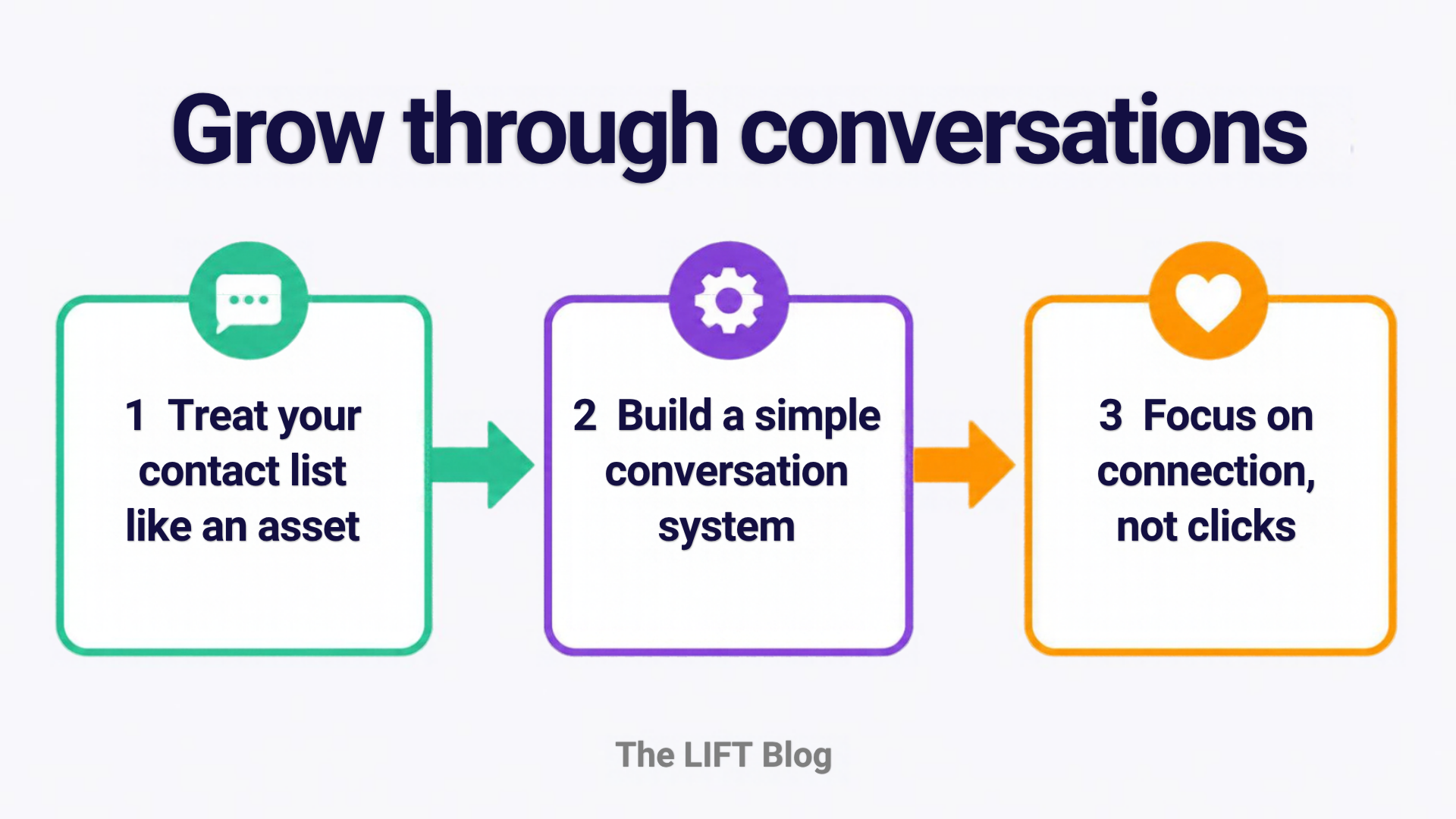
The path to sustainable growth is a simple, three-step system.
Step 1: Treat Your Contact List Like an Asset
The first step is a change in mindset. Your contact list, your CRM, your email database, whatever you call it, is not just a collection of data. It is one of the most valuable assets your business owns. It's a record of every person who has ever shown an interest in you, worked with you, or crossed your professional path.
So you need to start treating it like one. Instead of seeing it as a dusty old filing cabinet, see it as a private community. These are people who, at one point, raised their hand. Your job isn't to find thousands of new people. It's to serve the people who are already here.
Step 2: Build a Simple Conversation System
Once you see your contacts as an asset, you need a process for engaging with them. And this doesn't need to be complicated. A conversation system is simply a consistent, repeatable way to reach out, provide value, and start a dialogue.
It could be a simple monthly email where you share a helpful idea and ask a question. It could be a process for checking in with your top 25 past clients every quarter just to see how they're doing. The tool you use is less important than the consistency of the action.
The goal is to create a rhythm of communication that keeps you top of mind in a helpful, non-intrusive way.
Step 3: Focus on Connection, Not Clicks
Finally, you have to change how you measure success. The marketing world is obsessed with metrics like open rates and click-through rates. But those are vanity metrics. They don't pay the bills.
So the only metric that truly matters in this system is conversations. Did your outreach lead to a real, one-to-one conversation with another human being? That's the whole game. A single meaningful conversation is worth more than a thousand email opens. When you focus on connection, the business follows. You're not trying to optimize for clicks, you're trying to build real relationships.
Frequently Asked Questions
What are the most common marketing challenges of small business?
The most common challenge is feeling overwhelmed by the sheer number of marketing tactics available. This leads to a lack of focus and a strategy built on chasing attention, which is expensive and inefficient. The solution is to ignore the noise and focus on one system: activating the relationships you already have.
How much should a small business spend on marketing?
This is one of the most common questions, but it's often the wrong one to ask. The question isn't how much to spend, but what the return on that spending is. When you spend money chasing cold leads, the return is often low and unpredictable. But when you invest time in a system to generate conversations from your existing contacts, the return is significantly higher because you're starting with a warm audience.
Why do most marketing strategies fail for small businesses?
They fail because they are often scaled-down versions of corporate strategies. They are built on big budgets, complex technology, and the pursuit of mass attention. Small businesses win on relationships and trust, not volume. A successful strategy must be built around your greatest strength, which is your ability to create genuine human connections.
How do I grow my service-based business with my existing contacts?
You grow it by implementing a simple, consistent system to stay in touch.
Identify your key contacts (past clients, valuable prospects, referral partners).
Create a repeatable process to reach out to them regularly, offer something of value (an idea, an introduction, a helpful article), and invite a conversation.
Consistency is more important than complexity.
Your Next Step Is Simple
For years, you've been told that marketing has to be complicated. You've been sold on the idea that growth comes from constantly chasing more: more followers, more traffic, more leads. But that game is rigged against the small business owner.
The reality is simple. The greatest opportunities for your business are not in the strangers you haven't met, but in the relationships you've already built. The growth you're looking for is hiding in your "graveyard CRM," waiting for a simple conversation to bring it back to life.
This is one of the most effective marketing problems and solutions you can focus on.
So you don't need more complexity. You need a clear, simple system for turning those dormant contacts into active, meaningful conversations.
Ready to stop chasing attention and start building a system that generates real opportunities from the people you already know? Book a free strategy call to build your conversation blueprint.