The Hidden Risk of Using AI to Build Your Business Website
You have probably seen the videos on your feed. Someone types a single sentence into an AI tool, and a fully functional website appears in seconds. It looks like the perfect way to save time and money. But if you run a local business, relying on pure AI to build your website is a trap.
This new trend is called "vibe coding." You just describe what you want, and the AI writes the code. For a personal project or a quick test, it is amazing. I even use it for my own personal site.
But a website for a roofing company or an insurance agency is a different machine. It is an engine that needs to feed answers to Google and new AI search tools. If the underlying structure is a mess, you will be invisible to your customers.
Here is why the "vibe coding" trend is dangerous for your business, and what you should do instead.
Key Insights
The execution gap: AI website builders are great for fast prototypes but lack the stable infrastructure local businesses need.
The maintenance trap: "Vibe coding" creates beautiful sites on day one, but they break easily when you try to update them later.
The AEO shift: Answer Engine Optimization is replacing traditional SEO. Your site must be structured to feed answers to ChatGPT and Perplexity.
The solution: A hybrid approach gives you the speed of AI with the stability of a managed platform.
The Rise of Vibe Coding
The AI website builder market is growing fast. It hit $3.1 billion in 2024 and will reach $25 billion by 2035. Tools like Lovable, Bolt, and Manus are changing how things get made.
The market is shifting fast, but the growth is concentrated at the edges, leaving small businesses behind. Source: GreenGeeks.
You can build a polished site in hours using natural language prompts. You do not need to know HTML or CSS. You just tell the AI what you want, and it builds it.
For individual founders and solopreneurs, this is a massive advantage. It allows you to move fast and test ideas without hiring a developer.
But the market data shows a clear divide. The growth is happening at two ends of the spectrum. Individual founders are building simple apps. Enterprise teams are using AI to move faster. The middle is where the danger lives. Small local businesses are not being served well by pure AI builders.
The Trap for Local Businesses
Here is the catch. When you build a site using pure conversational AI, the code is often a tangled mess behind the scenes.
The site looks great on day one. Then you need to update a phone number, add a team member, or fix a broken contact form.
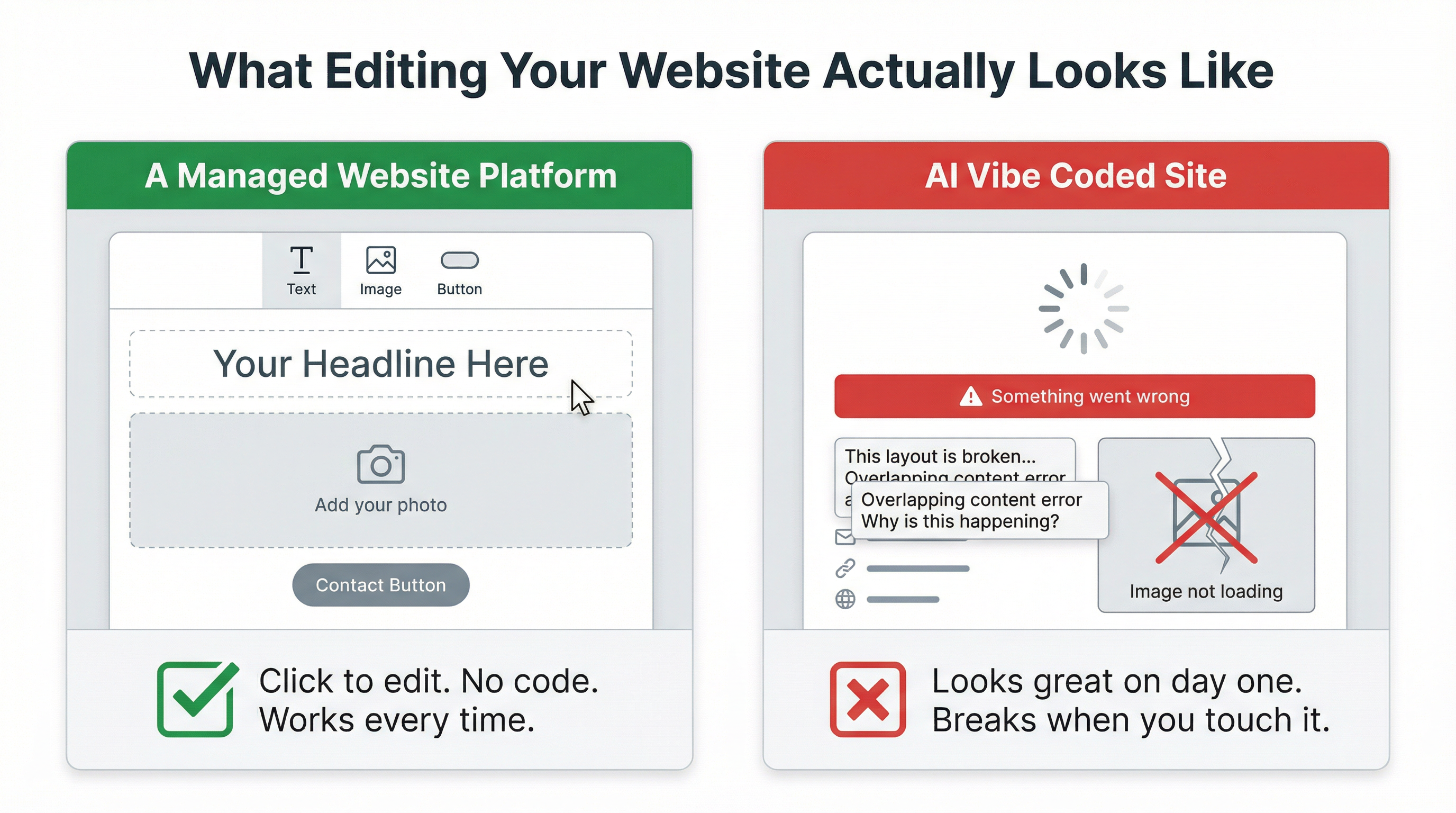
AI builders often generate proprietary code structures that are difficult to manage and limit your access to key SEO elements.
If you do not know how to read the code, you cannot fix it. If you ask the AI to fix it, it might overwrite your previous changes and break something else. You have no stable content management system. You have no clear hosting infrastructure.
This is not a theoretical problem. I recently saw a local roofing company try to build their site with an AI tool to save a few bucks. Two months later, their contact form broke silently after an AI update. They missed out on weeks of quoted jobs before they even realized no emails were coming through.
The financial impact is real. A recent study found that 67% of businesses report lost revenue due to poor website performance, and 40% say it directly impacts their ability to attract new customers.
You do not have time to debug AI-generated code on a Tuesday morning.
Small businesses need reliability. You need a system that works every time.
The Shift to Answer Engine Optimization
There is a bigger issue hiding under the surface. Traditional search is changing.
People are not just Googling anymore. They are asking ChatGPT, Perplexity, and Google AI Overviews questions like, "Who is the best independent insurance agent near me?"
This is Answer Engine Optimization, or AEO. More than half of marketing leaders say they will prioritize AEO in 2026. If you want these AI assistants to recommend your business, your website needs a very specific structure.
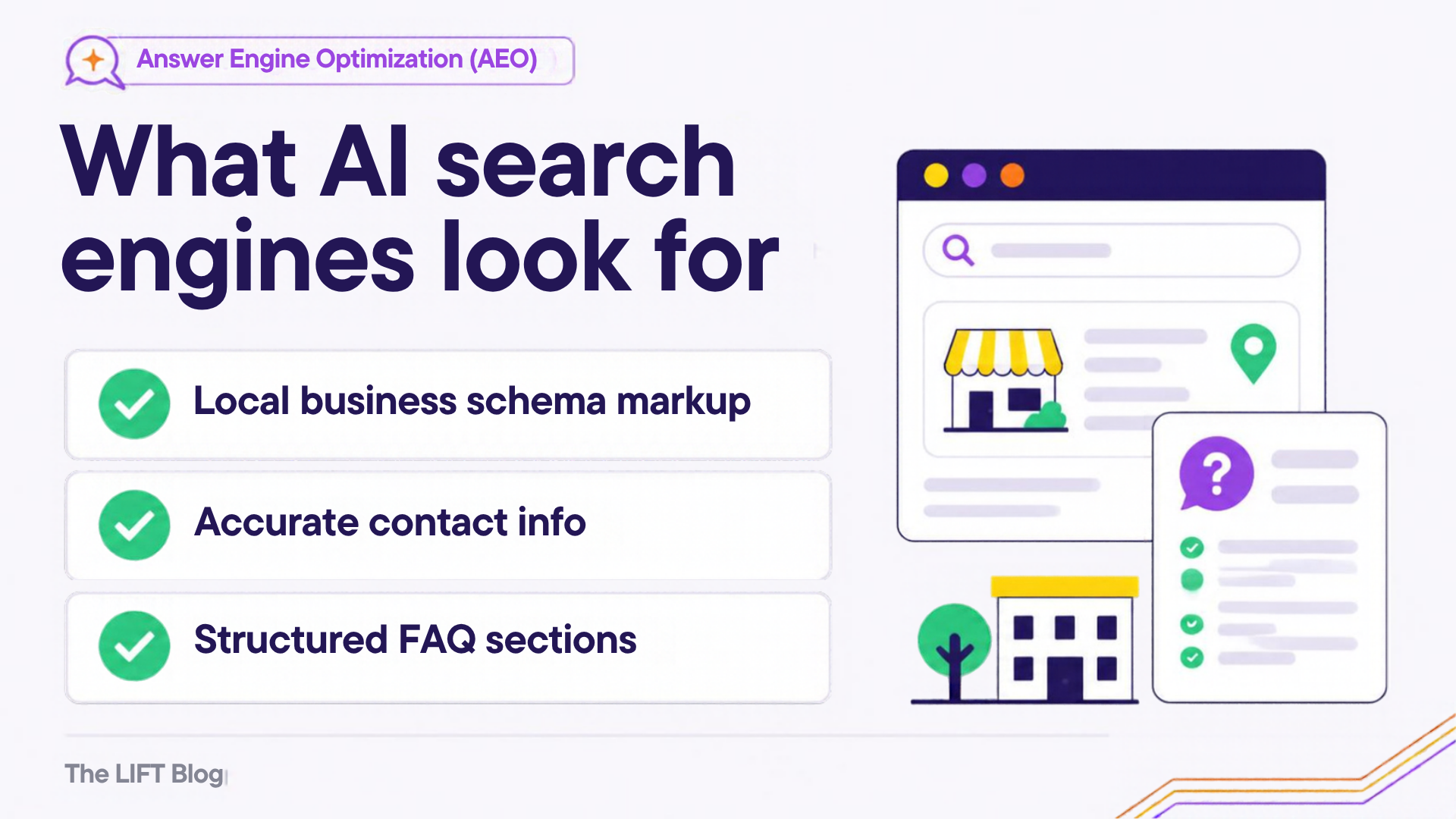
Answer Engine Optimization (AEO) requires a specific site structure that pure AI builders often struggle to provide.
AI engines look for clear data. They need local business schema markup, accurate contact info, and structured FAQ sections. Pure AI builders often generate proprietary code that limits your access to these exact structural elements.
Only 12% of URLs cited by AI tools rank in Google's top 10. You can rank on Google and still be invisible to AI search.
The Hybrid Solution
The best path forward is a hybrid approach.
A hybrid approach combines the speed of AI with the stability of a managed platform.
You want the speed of AI combined with the stability of a managed platform. This is why I use platforms I do for my clients. They embed AI directly into a stable, white-label infrastructure.
You can use AI to write copy, generate sections, and optimize metadata. It cuts the build time in half. The underlying code stays clean. The site loads fast, and the structure is perfectly optimized for AEO.
The reality is simple. You are not just building a website. You are building a system to capture local AI search visibility.
Do not let the hype push you into using the wrong tool. Use AI to speed up your work, but build on a foundation that will last.
If you want to see how we structure local business websites for AEO, let's talk.
See how your website ranks for SEO, AEO and GEO (Generative Engine Optimization by putting your site into our app.
Sources: GreenGeeks (AI Website Builder Market Data) • Webflow 2026 State of the Website Report • Momentum (AI Web Builder Limitations, March 2026) • ZipTie (Local SEO for AI Search) • Liquid Web Website Performance Study (April 2025)