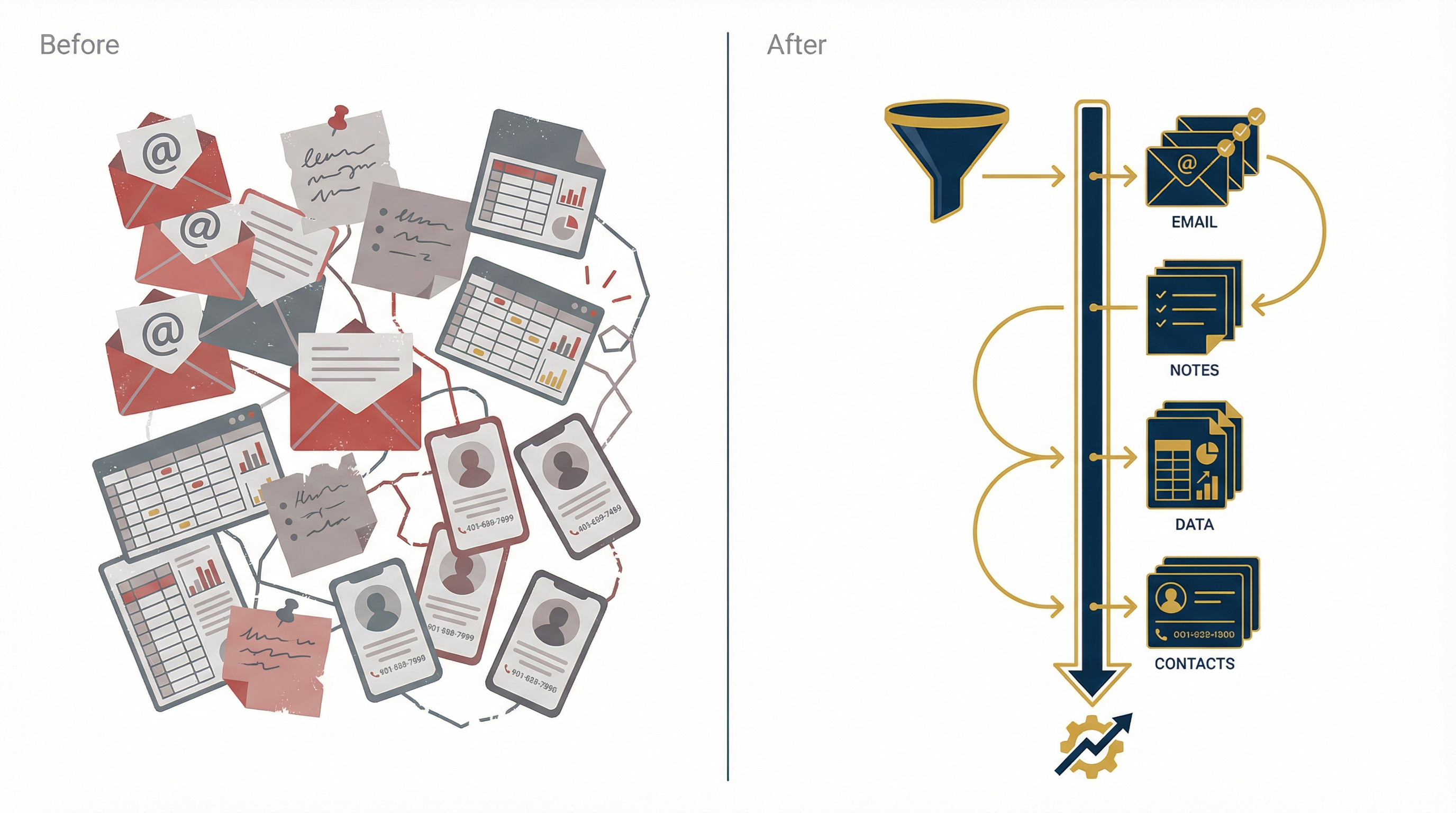
You Paid for Marketing and Got More Confusion
You hired the agency. You bought the software. You received the reports, filled with metrics and charts that were supposed to represent progress.
Yet, the needle hasn’t moved. Your days are no less chaotic, your sales are no more consistent, and you are left with a lingering sense of frustration. You paid for clarity and got a new layer of complexity.
I have been there. I once juggled over ten different marketing tools, watching good prospects slip away because nothing worked together. I learned that the problem was not a lack of leads, but a lack of a coherent system.
The constant chase for more was a distraction from the real issue hiding in plain sight: a broken operational foundation.
The problem is not the marketing agency, and it is rarely the tool. The real issue is the absence of solid marketing systems for small businesses. Without a clear internal process for managing contacts and communication, any external marketing effort is destined to create more noise, not more opportunities.

Key Takeaways
• Most businesses suffer from an operational marketing problem, not a lead generation problem.
• Adding more tools or hiring agencies without a solid internal system creates more chaos, not clarity.
• A single, centralized contact list is the non-negotiable foundation of a functional marketing system.
• The goal of automation for small businesses should be consistency, not complexity.
• Most businesses move from scattered data chaos to a unified system once they commit to operational clarity.Most businesses move from scattered data chaos to a unified system once they commit to operational clarity.Sustainable growth comes from fixing internal processes, not from buying external solutions.
The Familiar Story of Wasted Marketing Spend
Most businesses follow a predictable, and often disappointing, path. Growth feels slow, so the owner decides to invest in marketing. They hire a firm that promises leads.
The first month, a report arrives showing website traffic is up. The next month, it highlights a list of “MQLs” or marketing qualified leads. On paper, it looks like success.
What does that look like in reality?
The business feels the same. Those leads are just rows in a spreadsheet emailed over at the end of the month. They sit in an inbox, waiting for someone to manually enter them into a different system.
Some get a call, others are forgotten. A contact from a trade show six months ago still hasn’t received a follow-up email. The feeling is one of being overwhelmed with data but starved for real conversations.
This gap between reported activity and actual business results creates a dangerous impulse. The owner concludes the problem must be technological. The search begins for the perfect piece of marketing software for small business, a tool that promises to automate everything and connect the dots.
Another subscription is added. Another login is created. And the confusion deepens, because a new tool added to a broken process doesn’t fix the process. It just adds another silo of information.
Why Adding More Tools Is a Recipe for Chaos
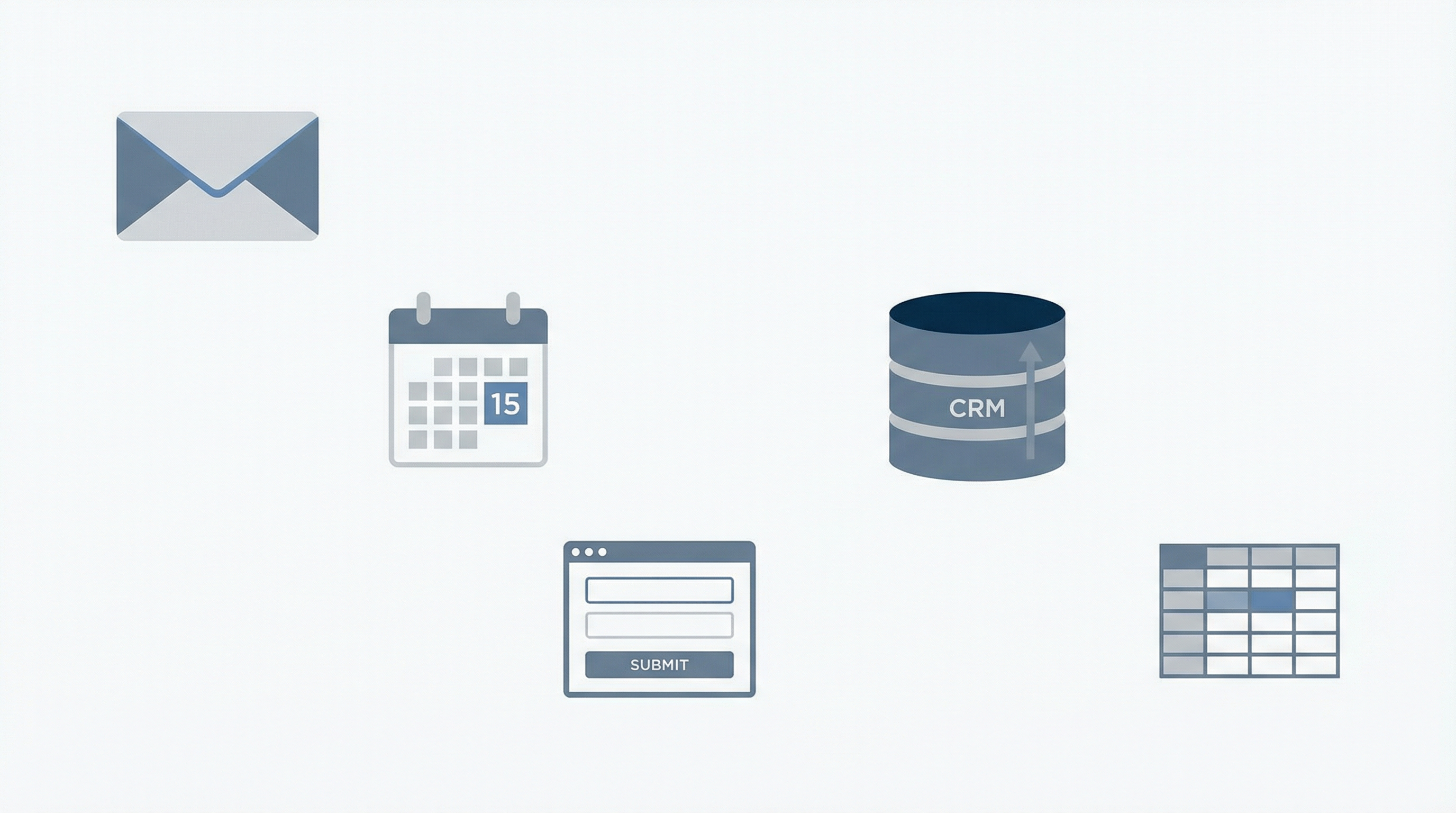
Adding more technology to a business without a solid operational structure is like trying to build a second story on a house with a cracked foundation.
The new addition may look impressive for a moment, but it only adds weight to a system that is already failing. It accelerates the collapse.

Here's the deal: New tools do not create more clarity. They create more places for things to get lost.
When you add software without a system, you create predictable problems. These issues are not features of the software; they are symptoms of a flawed operational approach.
Many businesses invest in powerful email marketing automation platforms, believing the software itself will solve their follow-up problem. But the platform is useless if the contact list is a disorganized mess and there is no clear strategy for what to say.
The tool cannot invent the system. It can only execute the one you give it.
The Real Issue: An Operational Marketing Problem
Most businesses do not have a lead generation problem. They have an operational marketing problem. They focus all their energy on finding new people to talk to, while the people they already know are neglected.
The real opportunity for growth is not in adding more at the top of the funnel, but in fixing the leaks within it.
Operational marketing is the internal framework a business uses to manage data, communication, and follow-up with every contact it has. Unlike lead generation, which focuses on acquiring new names, operational marketing focuses on building systems to convert existing contacts into real opportunities.
It is the foundation that makes all other marketing efforts effective.
This is the work that happens before and after you get a lead. It is the system that ensures every contact, whether from your website or a networking event, is captured, organized, and communicated with in a consistent way.
It is about building a reliable engine for growth inside your business, rather than constantly trying to buy it from the outside.
A business with strong operational marketing can make the most of just ten new leads a month. A business with weak operations can waste a thousand.
The goal is to build a system where every contact is valued and nurtured. The best crm and marketing automation software can support this system, but it can never replace it.
The system comes first. The tool serves the system.
From Data Chaos to Real Opportunities: An Insurance Agency’s Story
Let’s make this real. Consider a small, independent insurance agency in Michigan we worked with. They had a database of over 1500 clients collected over 2 decades, but their communication was sporadic at best. Why?
Their CRM was a beast. In an attempt to “know everything,” they had created over 150 data fields for each contact, every possible policy type, renewal dates, car models, spouse’s birthdays, you name it. The sheer complexity was paralyzing. The team felt so overwhelmed by the data they were supposed to be tracking that they ended up doing nothing at all.
They hired a marketing agency that promised more leads, which only made the problem worse. New leads were dumped into the already chaotic system, becoming just another row in a spreadsheet, and were quickly forgotten.
The Solution: Radical Simplification
Instead of adding another tool, we focused on the operational foundation. We decided to ignore the 150+ data points and focus on just 7 essential fields:
Name
Email
Physical Address (for direct mail)
Client Type (Client, Lead, etc)
Source (where did they meet them originally)
Birthdate (to send out birthday messages)
Policy Anniversary Date (to set up automated policy anniversary reviews)
This act of strategic subtraction was the game-changer. With a clean, simple list, they could finally act.
The Results: Tangible Growth from Existing Contacts

With their newly organized data, they launched a simple, automated email campaign to their 2,500 active clients, inviting them to schedule an annual policy review. The results were immediate and profound:
• 120 policy review appointments were booked in the first two months.
• These reviews uncovered opportunities for 45 new policies with their existing clients.
• This translated to over $35,000 in new annual premiums, all without spending a dime on new leads.
This agency didn’t need more leads; it needed a system to calmly and consistently engage the people it already knew. They stopped paying for confusion and started building a foundation for real, sustainable growth.
Three Steps to Build a Marketing System That Works
Building a functional system is not about complexity or buying expensive software. It is about making a few strategic decisions and committing to a process. It is about choosing clarity over chaos.
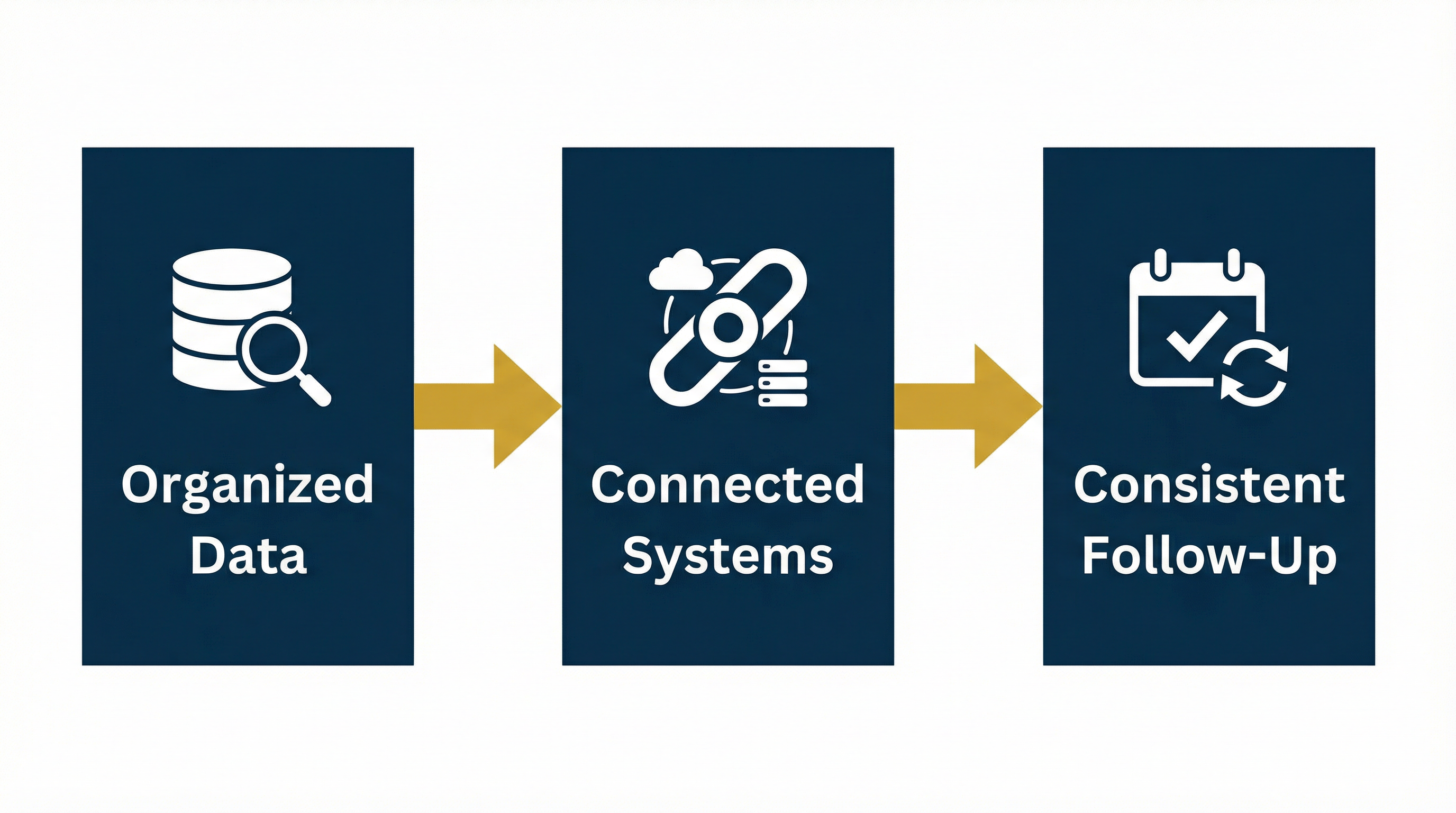
Here are the three fundamental steps to building marketing systems for small business that actually work.

Organize Your Data. The entire system begins here. Your contact data is likely spread across your email client, your accounting software, your phone, and a dozen old spreadsheets. The first step is to consolidate it all into one central, clean list. This single source of truth is the non-negotiable foundation. Decide what information is essential (name, email, company, last contact date) and get it all in one place.
Connect Your Systems. Once you have a central hub for your data (often a simple CRM), the next step is to connect it to the other tools you use. The goal is to eliminate manual data entry. Your website contact form should automatically add new contacts to the central list. When you book a meeting, it should be logged in the contact’s record. The aim is not to connect everything, but to connect the few essential tools that handle customer interaction.
Automate Your Follow-Up. This is where marketing automation for small businesses becomes powerful. With an organized list and connected systems, you can now build simple, automated sequences. This is not about sending generic email blasts. It is about ensuring every new contact receives a prompt welcome. It is about sending a gentle reminder to a prospect you haven’t heard from in 90 days. It is about creating consistent, personal touchpoints that build relationships over time, without relying on your memory.
Your Questions, Answered
"Isn't marketing automation too expensive or complicated for my small business?"
That's a common myth, mostly because the industry focuses on complex, multi-step funnels. For a small business, the goal of automation isn't complexity; it's consistency.
Think of it less as a "funnel" and more as a simple recipe. For example:
• IF a new contact fills out our website form,
• THEN automatically send them our welcome email.
That one, simple automation is more powerful than a hundred manual follow-ups that only happen when you remember. The cost of a simple automation tool is tiny compared to the cost of lost opportunities and inconsistent communication.
"Where do I even start? My contact data is a complete mess across 10 different places."
Feeling overwhelmed is the #1 reason businesses never start. The key is to ignore the mess and focus on creating a single, clean list. Here’s a simple, three-step process you can start today:
The Ugly Export: Go into every tool you use, your accounting software, your email client, your phone contacts, old spreadsheets, and export everything into one master spreadsheet. Don't try to clean it yet. Just get it all in one place.
Define Your Essentials: Create a new, clean spreadsheet with only the handful of columns that actually matter for communication. Start with the essentials we used in the case study: Name, Email, Client Status, Last Contact Date, and Primary Interest.
The Clean Fill: Go through your ugly master spreadsheet and copy-paste the relevant information into your new, clean spreadsheet. Ignore the other ,145 data points for now. This clean list becomes your new "single source of truth." To make this go faster you can use AI tools like ChatGPT or Manus to let AI do the heavy lifting.
This process costs nothing but a few hours of focused time, and it is the single most important step toward building a functional system.
"What is the one thing I can do today to make a real difference?"
Write down a simple, repeatable follow-up process for a single source of new contacts. For example, for every new contact from your website:
Day 1: Send a personal welcome email (can be automated).
Day 7: If no reply, send a follow-up with a helpful resource.
Day 30: If still no reply, add them to your monthly newsletter.
Write it on a sticky note and put it on your monitor. That simple, documented process is the beginning of a true marketing system.
Stop Buying Confusion, Start Building Clarity
The endless cycle of hiring agencies and buying software is a symptom of a deeper issue. The search for an external solution is a distraction from the necessary internal work.
Real, sustainable growth does not come from another monthly report or another software subscription. It comes from building a simple, reliable system inside your business.
This work is not glamorous. It does not involve viral content or clever advertising hacks. It is the quiet, essential work of organizing data, defining processes, and ensuring every single person you know is treated with consistent attention.
It is the foundation upon which all other marketing becomes effective.
The bottom line is this:
Stop buying confusion. Start building clarity.
Before You Hire a Marketing Agency, Read This
Feeling inspired to hire a marketing agency? That's a great step, but it's crucial to have your internal systems in order first. An agency can only amplify what you already have.
To help you prepare, I've created a simple guide: 5 Critical Questions to Ask Before You Hire a Marketing Agency.
This guide will walk you through the essential questions you need to ask yourself and any potential agency to ensure you're setting yourself up for success, not more confusion.