Naruto performing the Shadow Clone Jutsu, representing the power of business automation and scaling.

Stop Being the Lone Ninja: How Naruto's Shadow Clone Technique Reveals the Real Secret to Scaling Your Business

February 21, 202611 min read

Naruto performing the Shadow Clone Jutsu with dozens of clones appearing behind him against a city skyline backdrop, representing business scalability.

One person. One mission. Infinite reach.

You feel the burnout. You are the best performer on your team, the lone ninja carrying the weight of every client relationship and every sale. You believe that to grow, you must simply work harder, move faster, and be in more places at once. But you are hitting a wall.

You have heard the advice before: "You need a CRM." "You need to automate." You may have even tried, only to create a robotic mess that felt inauthentic and complicated.

The problem is not the advice. The problem is the order of operations. You have been trying to use advanced ninja tools without first mastering the fundamentals of your own energy and intent.

You cannot multiply yourself effectively until you first clarify your mission. This is the central lesson of Naruto's Shadow Clone Technique, and it is the key to unlocking scalable growth without sacrificing your soul.

This is not another post about why you need a CRM. This is a post about the identity shift you must make, from a lone warrior to a strategic architect. It is about how to prepare yourself to lead an army of effective, autonomous clones.

Key Insights

• Stop Being the Hero: The belief that you must personally handle every touchpoint is the biggest bottleneck in your business. The goal is not to do more work, but to multiply your impact.

• Clarity Before Clones: Automation without a clear mission creates robotic, ineffective communication that damages trust. You must "brief" your systems just as Naruto briefs his clones.

• Energy Determines Scale: You cannot automate what you do not understand. The "chakra" required to create effective clones is a deep clarity about your customer's journey and your desired outcomes.

• Your Systems Must Learn: The most powerful part of the Shadow Clone technique is that the clones' experiences return to the original. Your business systems must do the same, feeding you data that makes you smarter.

The Lone Ninja’s Trap: Why Hustle Always Hits a Ceiling

Every ambitious founder starts as the lone ninja. You are driven, skilled, and have a high tolerance for pain. This is your superpower, and it gets you off the ground. But it quickly becomes a trap.

You believe your personal touch is the magic ingredient in every sale and every relationship. And you are not wrong. The problem is that this belief, when unchecked, makes you the bottleneck. Your business cannot grow beyond the number of hours you can personally work.

When you try to scale by simply “hustling harder,” you do not get more effective. You get tired. You miss follow-ups. You drop balls. Your personal touch, spread too thin, becomes a liability.

This is the moment most founders look for a tool to solve their capacity problem. They buy a CRM or an automation platform, hoping it will be a magic button. But it never is.

Your personal effort got you here. It will not get you there.

Anime-style ninja overwhelmed at a chaotic desk covered in paperwork and ringing phones, representing the burnout of doing everything manually.

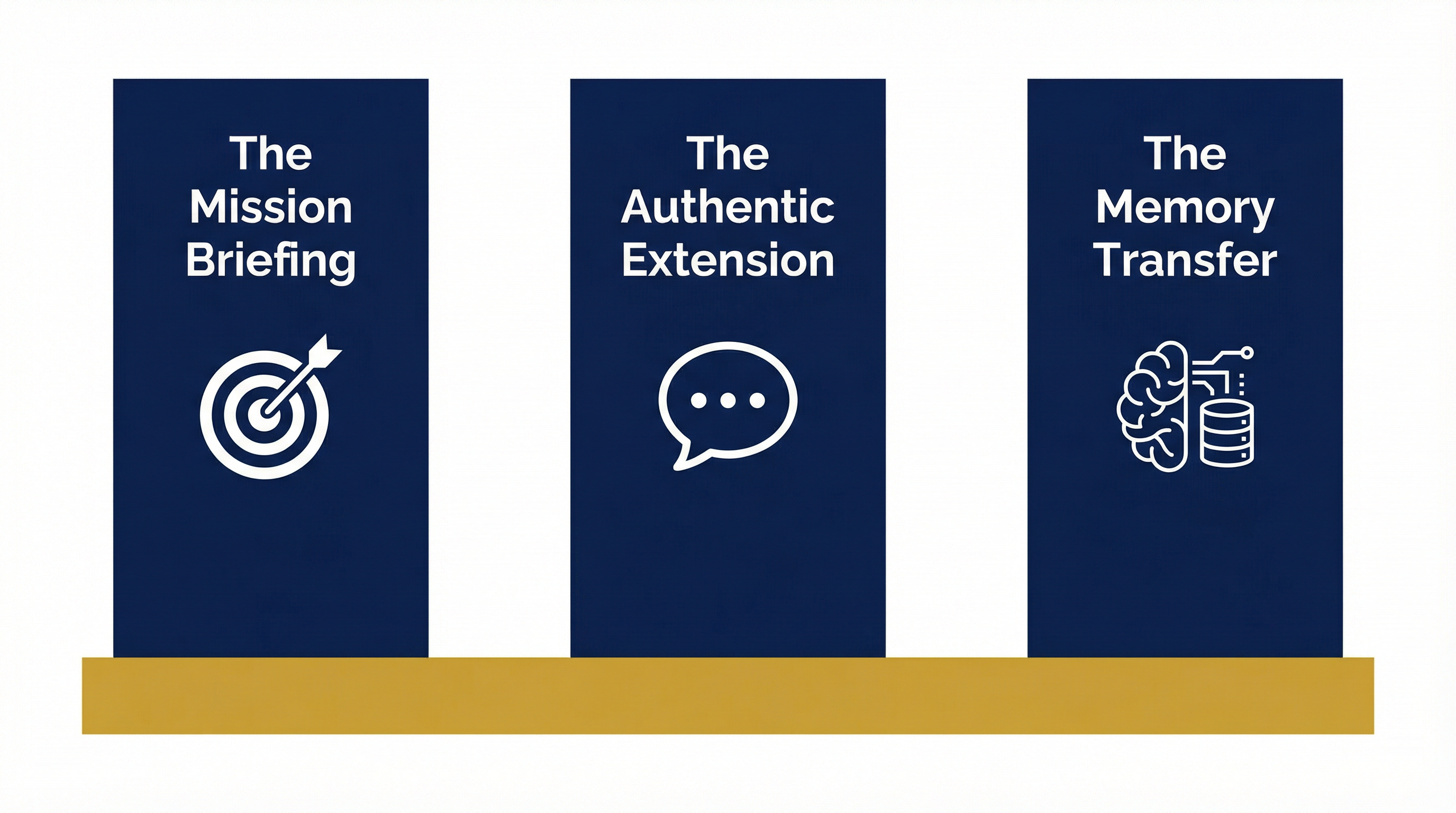
The Three Pillars of the Shadow Clone System

To truly scale, you must stop thinking about what you can do and start thinking about what your systems can do. This requires a new framework, one built on the principles of Naruto's most powerful technique.

Pillar 1: The Mission Briefing (Clarity Before Clones)

When Naruto creates a shadow clone, he gives it a mission. One clone is sent to scout, another to train, another to create a diversion. Each clone has a purpose.

Most business owners do the opposite. They set up an automation, a "clone," and just hope it works. They create a generic email sequence and blast it to everyone, wondering why it feels robotic and gets no replies.

An automation without a clear mission is just spam. It is a clone sent into battle without instructions. It will be ineffective at best and counterproductive at worst.

Before you write a single automated email, you must complete the mission briefing. For every touchpoint you want to create, you must be able to answer:

  • What is the single most important feeling I want this person to have after this interaction? (e.g., understood, curious, reassured)

  • What is the single most important piece of information I want them to know? (e.g., we have a plan, this is the next step, here is a resource)

  • What is the single, clear action I want them to take? (e.g., book a call, read a blog post, reply with a question)

If you cannot answer these questions with absolute clarity, you are not ready to create a clone. Your lack of clarity will be felt by the recipient, and your message will be ignored.

Split-panel anime illustration showing a confused, unbriefed shadow clone on the left versus a sharp, mission-ready clone receiving instructions on the right.

A clone without a mission is just noise. A clone with a mission is a force multiplier.

Pillar 2: The Chakra Threshold (Knowing When You are Ready to Scale)

In Naruto, the Shadow Clone Technique is a forbidden jutsu for a reason. If a ninja with low energy (chakra) tries to use it, they risk complete exhaustion or even death. They cannot sustain the clonesIn business, this is the danger of premature automation. Founders who lack clarity, the business equivalent of chakra, and try to automate their marketing often burn out, waste money, and damage their brand.

Your business has a Chakra Threshold. It is the minimum level of operational clarity required to sustain automated systems. Trying to scale before you meet this threshold is why your past efforts have failed.

What does this clarity look like?

•You have a single, clean contact list. You are not pulling names from five different spreadsheets and your phone.

•You know the 3-5 most important stages of your customer’s journey. (e.g., Initial Inquiry > Discovery Call > Proposal > Closed Won/Lost).

•You have a basic understanding of what needs to happen at each stage.

If you do not have these things, you have low chakra. You are not ready for an army of clones. Your mission is not to buy more software; it is to sit down and achieve this foundational clarity. Only then can you begin to build systems that will not collapse under their own weight.

Two-panel anime illustration of Naruto with low chakra failing to sustain clones on the left, and Naruto with full chakra summoning a powerful clone army on the right.

Clarity is the energy that fuels your systems. Without it, your clones will not hold.

Pillar 3: The Memory Transfer (Turning Clone Experience Into Owner Intelligence)

The most profound aspect of the Shadow Clone Technique is not the multiplication itself, but what happens after. When a clone is dispersed, all of its experiences and knowledge are transferred back to the original Naruto. He learns what the clone learned.

This is the most overlooked and powerful part of building a system. Your automations are not just workhorses; they are intelligence agents. Every email they send is an experiment. Every open, click, reply, or unsubscribe is data. It is a clone returning with a report from the field.

Most business owners build a system, turn it on, and walk away. They never complete the memory transfer. They are sending out an army of clones but refusing to listen to their reports.

An effective system is a feedback loop. It should tell you:

  • Which subject lines are getting opened?

  • Which calls to action are getting clicked?

  • At what point in your sequence do people lose interest?

  • Which of your resources are most valued?

This is not just data. This is wisdom. It is the collective experience of your clones, delivered to you on a dashboard. It allows you to stop guessing and start knowing what your audience wants. By reviewing this data weekly, you are absorbing the lessons from the field and becoming a smarter, more effective leader.

Anime illustration of Naruto meditating as shadow clones dissolve and transfer golden streams of knowledge and data back into his mind.

Every clone that returns makes the original stronger. Your systems should do the same.

Alex’s Transformation: From Lone Ninja to System Architect

Consider Alex, a talented freelance consultant. For years, Alex was the lone ninja, believing that personal effort was the only path to quality. Every email was handwritten, every follow-up was from memory. The business was successful, but Alex was a prisoner in it.

Alex’s first attempt at automation was a disaster. Hearing that “you need to automate,” Alex bought a tool and set up a generic, 7-day email sequence for all new leads (a clone army with no mission briefing). The result? A few prospects replied, “Is this an automated email?” Trust was broken, and Alex immediately shut it down, retreating to the familiar comfort of manual work.

The real breakthrough came when Alex stopped focusing on tools and started focusing on intent. Alex mapped out the customer journey and, for each stage, wrote out the Mission Briefing. What did a new lead really need to feel? Reassured and understood. What did a prospect who just had a great call need? Clarity on the next steps.

With this new clarity (chakra), Alex built two simple clones:

1.The “Handshake” Clone: A single, plain-text email sent immediately after a new inquiry. It was not a sales pitch. It simply said, “Thanks for reaching out. I’ve received your info and will personally review it and get back to you within 24 hours. In the meantime, here’s a post I wrote about [their stated problem].”

2.The “Next Steps” Clone: A follow-up sent 2 hours after a discovery call was logged. It summarized the call’s key points (which Alex typed in as a note) and clearly outlined the next step.

These clones were not robotic because they were briefed with clear, empathetic intent. They did not replace Alex; they multiplied Alex’s best intentions. They ensured that every single person received the perfect, timely handshake and follow-up, even when Alex was in another meeting.

Most importantly, Alex started the Memory Transfer, reviewing the open and click rates each Friday. Alex learned that the “Handshake” email had a 92% open rate, confirming that people craved that initial reassurance. Alex had become a true System Architect.

Before-and-after anime illustration showing a frantic lone ninja on the left transforming into a calm system architect with multiple clones working efficiently on the right.

The goal is not to do more. The goal is to multiply your best intentions.

Your Questions, Answered

1. I am not a tech person. Isn't this just going to be another overwhelming project?

This framework is less about technology and more about thinking. The mistake is starting with the tool. Start with a piece of paper. Write down the answers to the Mission Briefing questions for your most common scenarios. Once you have that clarity, the technology becomes simple. You are just telling the tool what you have already decided to do.

2. How do I find the time to build all this when I am already drowning?

You do not build it all at once. You start with one clone. Just one. Identify the single most repetitive, soul-crushing communication task you do every day. Is it the initial reply to a new lead? Is it the follow-up after a first meeting? Build a single, simple clone for that one task. The 30 minutes it takes to build will save you hours within the first month, giving you the time and energy to build the next one.

3. My business is built on high-touch, personal relationships. How can a clone ever replace me?

A clone should never replace you. It should do the reliable, systematic work so that you can do more of the high-touch, personal work. A good system handles the handshake so you can focus on the deep conversation. It remembers to follow up so you can spend your mental energy crafting the perfect proposal. It is not about replacing your humanity; it is about scaling your best intentions.

The Path to Mastery

The journey from a lone ninja to a strategic leader of a clone army is an identity shift. It requires you to trade the ego-driven satisfaction of "doing it all yourself" for the quiet power of a system that works for you.

Your goal is not to become a master of marketing automation software. It is to become a master of your own intent. When you are clear on your mission, your clones will be effective. When you have enough chakra, your systems will be sustainable. And when you embrace the memory transfer, you will become an unstoppable, learning machine.

Stop trying to be everywhere at once. Start by clarifying what you want to happen, and then build a single clone to do it for you. That is the first step to mastering the ultimate technique for scaling your business.

Ready to see where your clones should be deployed first? Get a free, instant marketing audit report for your business. It analyzes your website, Google presence, and social media to reveal the hidden opportunities you can capture with your first automated systems. Get your free report here: https://report.liftmarketingsystem.com/

Nathan Klug is an educator, founder, and operator who helps small businesses simplify their operations and turn existing contacts into real opportunities. As the creator of LIFT Growth Systems, he guides business owners away from marketing chaos and toward clear, sustainable growth.

Through his four core offerings, the LIFT Marketing System, Authentic Engagement Agent, Content Engine, and Authority Engine, Nathan provides a complete framework to start conversations, nurture relationships, and build lasting brand authority. He believes in systems over tactics and consistency over cleverness, helping leaders stop buying leads and start having authentic conversations with their ideal prospects.

With over 15 years of experience building teams and running marketing operations, Nathan is known for his calm, direct approach. He helps people see exactly what is happening inside their business and bridges the gap between scattered ideas and scalable execution.

Nathan Klug

Nathan Klug is an educator, founder, and operator who helps small businesses simplify their operations and turn existing contacts into real opportunities. As the creator of LIFT Growth Systems, he guides business owners away from marketing chaos and toward clear, sustainable growth. Through his four core offerings, the LIFT Marketing System, Authentic Engagement Agent, Content Engine, and Authority Engine, Nathan provides a complete framework to start conversations, nurture relationships, and build lasting brand authority. He believes in systems over tactics and consistency over cleverness, helping leaders stop buying leads and start having authentic conversations with their ideal prospects. With over 15 years of experience building teams and running marketing operations, Nathan is known for his calm, direct approach. He helps people see exactly what is happening inside their business and bridges the gap between scattered ideas and scalable execution.

LinkedIn logo icon
Instagram logo icon
Youtube logo icon
Back to Blog