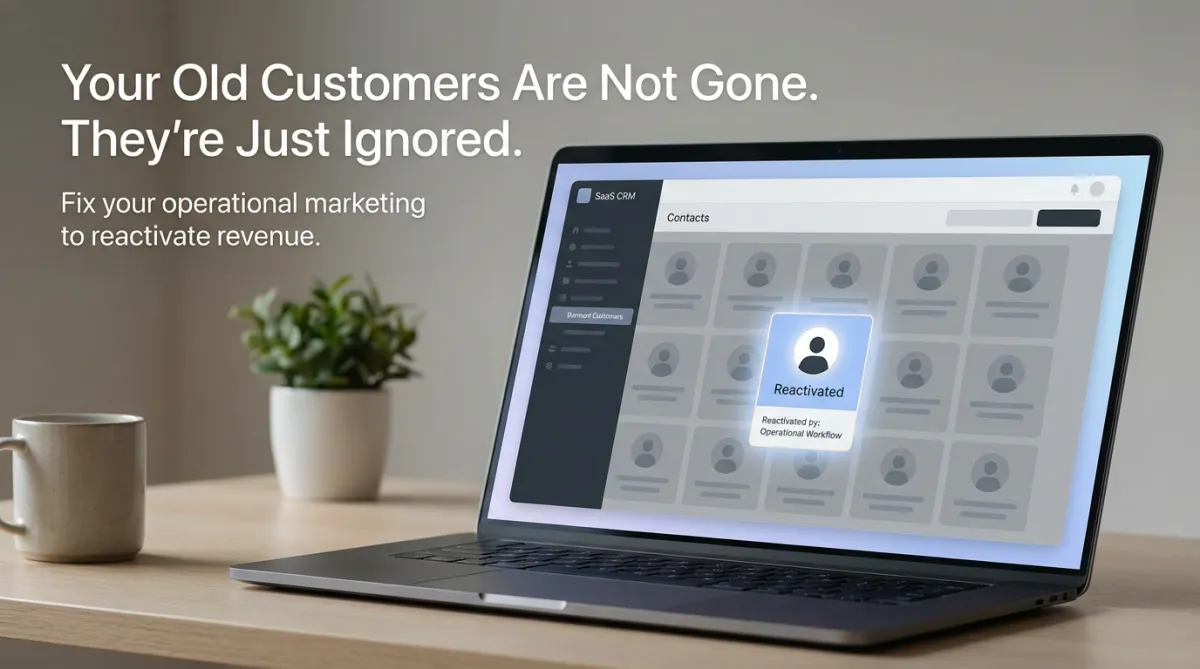
Your old customers aren’t gone—they’re sitting in your CRM, waiting for a system that consistently follows up.

Your Old Customers Are Not Gone. They Are Just Ignored.

January 15, 20269 min read

Key Insights

  • Dormant lists are an operational failure. Silence from your leads usually stems from broken internal systems, not a lack of customer interest.

  • Campaigns are temporary; systems are permanent. A "win-back" blast offers a one-time spike, while an automated follow-up process delivers consistent revenue.

  • Reactivation costs less than acquisition. It is significantly more profitable to wake up an existing contact than to pay for a new one.


Most businesses think they need more leads.

They spend their days chasing new traffic, optimizing ad campaigns, and posting on social media, all in the hope of filling the top of their funnel.

But there is a catch.

The real opportunity is not out there. It is already sitting inside your business, in a spreadsheet or a CRM, collecting dust.

I learned this firsthand when I was juggling over ten different marketing tools. I watched good prospects slip away, not because they weren’t interested, but because my follow-up was a mess. Nothing worked together, and opportunities went cold.

When your tools don’t connect, your follow-up breaks and good leads quietly slip through the cracks.

When your tools don't connect, your follow-up breaks and good leads quietly slip through the cracks

The problem was not a lack of interest from my audience. The problem was a lack of a coherent system on my end.

This is not a theoretical problem. It is an operational one.

The solution is not to launch another clever "win-back" campaign. The solution is to build a system that prevents good contacts from going cold in the first place. You can reactivate dormant customers by fixing your operational marketing, and I am going to show you how.


The Real Cost of a Dormant List

Reactivation typically costs less than acquisition—so dormant lists aren’t “dead,” they’re under-managed revenue.

Reactivation typically costs less than acquisition, so dormant lists aren't "dead," they're undermanaged revenue.

A dormant contact list feels like a missed opportunity. The actual cost is much higher.

It is a quiet tax on your entire business, draining resources and slowing growth in ways that are not immediately obvious.

1. The Acquisition Cost You spent money, time, or both to get every single one of those contacts. You paid for the ad, created the content, or attended the networking event. Letting that contact go dormant is like buying inventory and letting it rot on the shelf.

You spent money to acquire a customer, then you spent more money to acquire a new one to replace the one you ignored. This is a losing equation.

2. The Brand Perception Cost Silence is a form of communication. When a prospect hears from you once and then never again, the message they receive is one of disorganization. When a past customer is forgotten, they feel like a transaction. This quiet neglect erodes the trust you worked hard to build.

3. The Operational Cost A messy, dormant list is an operational drag. It makes your data unreliable and your team uncertain. Every time you want to send an email, you have to wonder who you are even talking to.

Your dormant list is not a marketing failure. It is a sign that your internal systems are broken.


Stop Chasing Campaigns. Start Fixing Your System.
The typical response to a cold list is to brainstorm a "win-back campaign."

This usually involves a steep discount, a catchy subject line, and a blast to everyone who has not opened an email in 90 days. It might create a small spike in sales, but it does nothing to solve the underlying problem.

A month later, the list is cold again.

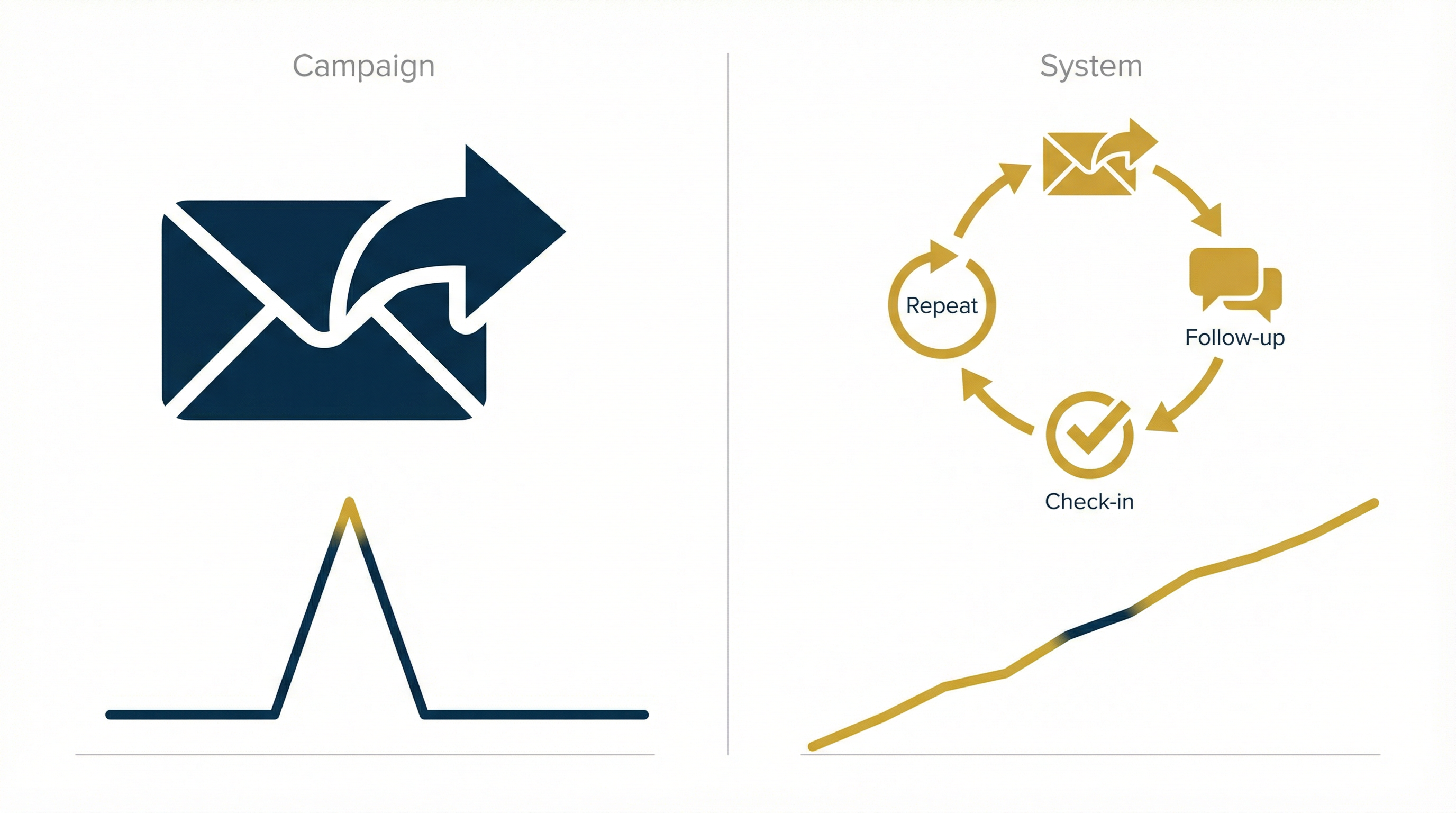
Campaigns are temporary. Systems are permanent.

Win-back campaigns are the visible tip; real reactivation comes from the operational system underneath.

Win-back campaigns are the visible tip; real reactivation comes from the operational system underneath

The reason most efforts to manage dormant leads fail is that they treat the symptom, not the cause. The cause is a breakdown in Operational Marketing. This is the practice of fixing your internal systems; data, follow-up, and automation to create growth from the contacts you already have.

It is less glamorous than a viral video, but it is infinitely more effective.

A campaign is an event that requires a burst of energy. A system is a process that runs continuously in the background, reliably turning contacts into conversations.


A 3-Step System to Revive Dormant Contact Lists

Reviving a dormant list does not require a complex strategy. It requires a simple, repeatable system built on three core principles: organization, value-based communication, and automation.

Step 1: Organize Your Data

Start by consolidating contacts into one source of truth, then segmentation becomes simple and follow-up becomes reliable.

Start by consolidating contacts into one source of truth, then segmentation becomes simple and follow-up becomes reliable.

You cannot speak to someone effectively if you do not know who they are.

The first step is to get all your contacts into one place a "Single Source of Truth." This is usually a CRM (Customer Relationship Management) tool. Export your contacts from your email marketing software, your accounting software, your phone, and any spreadsheets you have lying around.

Once they are in one place, you need to segment them. Do not overcomplicate this. Start with simple tags based on their history:

  • Lead Source: Where did they come from? (e.g., Website, Referral, Event)

  • Engagement Status: What is their last known interaction? (e.g., New Lead, Active Customer, Dormant Customer)

  • Interest: What did they show interest in? (e.g., Service A, Product B)

This simple act of organization transforms a messy list into a clear map of your audience.


Step 2: Build a Simple Follow-Up Sequence

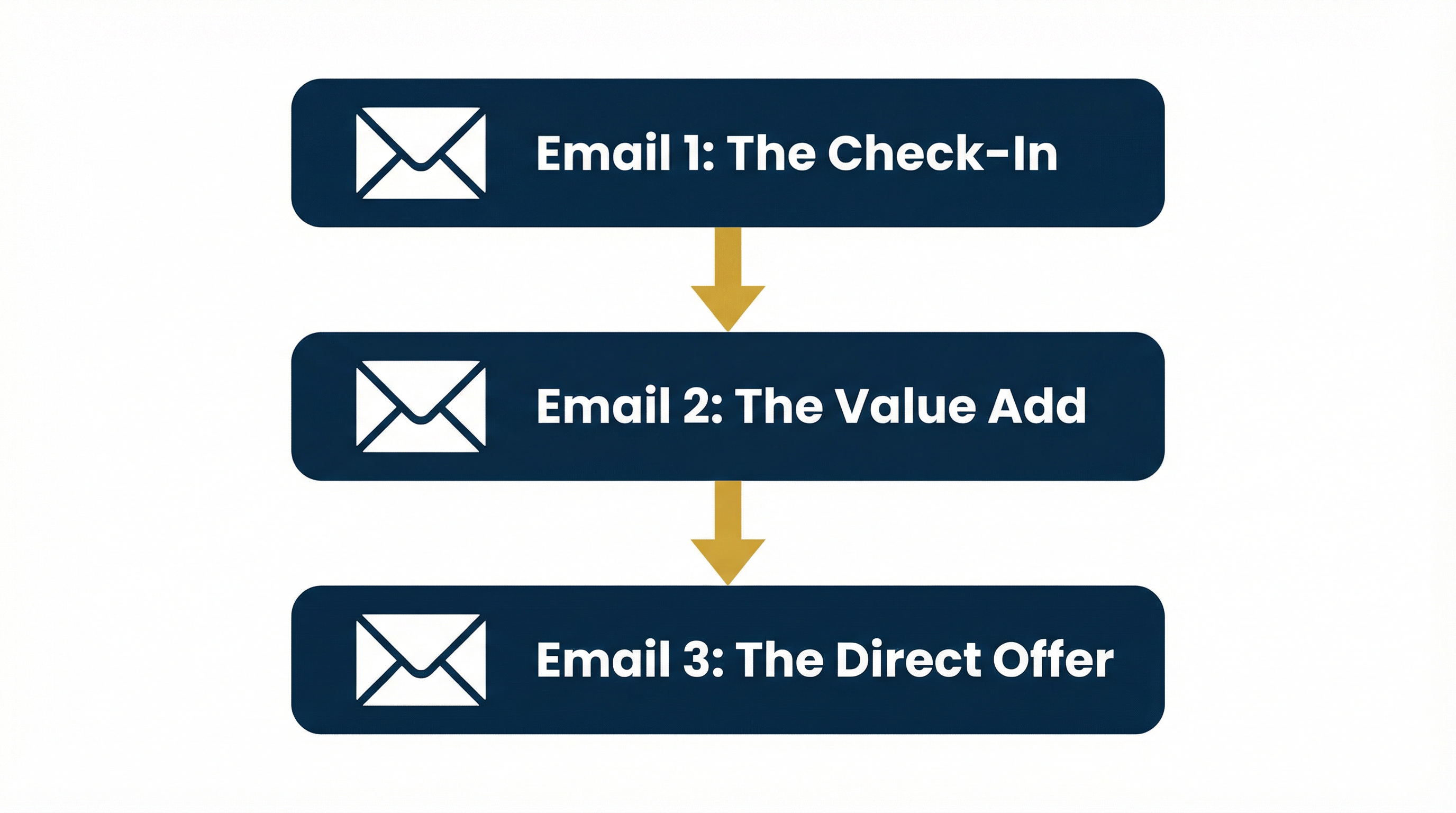
A short, value-first sequence beats a discount blast: re-introduce, give value, then check in one last time.

A short, value-first sequence beats a discount blast: re-introduce, give value, then check in one last time.

With organized data, you can build a follow-up sequence that feels personal and relevant.

The goal here is not to sell. The goal is to re-engage. A dormant contact does not need a 20% off coupon. They need to be reminded why they were interested in you in the first place.

Your sequence could be as simple as three automated emails sent over two weeks:

Email 1 (The Re-Introduction) A plain-text email that asks a simple question. This is low-pressure and focused on them, not you.

"Hi [First Name], are you still interested in [Topic]? Or did you take care of it?"

Email 2 (The Value Offer) Share a helpful resource related to their original interest. This could be a blog post, a short guide, or a link to a useful tool. You are giving, not asking.

Email 3 (The Final Check-In) Another simple, direct question.

"Just checking in one last time. If you’re no longer interested, no problem at all. If you are, just reply and let me know."

This approach respects their time and inbox. It filters for interest without being aggressive.

Step 3: Automate and Measure

Automation prevents leads from going cold by triggering the right follow-up the moment inactivity hits your threshold.

Automation prevents leads from going cold by triggering the right follow-up the moment inactivity hits your threshold

The only way to ensure this process runs consistently is to automate it.

Your CRM should be able to trigger the follow-up sequence automatically when a contact meets certain criteria (e.g., no engagement for 90 days). Automation ensures that no one slips through the cracks. It works every day, for every contact, without you having to think about it.

Once it is running, track two key metrics: open rates and reply rates.

  • Low open rate? Your subject lines are not compelling.

  • Low reply rate? Your email content is not resonating.

Use this data to make small adjustments to your sequence over time.


Marketing Ideas That Work (Because Your System is Fixed)

Once your system is solid, these reactivation plays work better: survey to re-segment, refresh a resource, or send a quick personal video.

Once your system is solid, these reactivations plays work better: survey to re-segment, refresh a resource, or send a quick personal video

Once your system is in place, you can start experimenting with different tactics. The difference is that now your ideas have a foundation to stand on.

Here are a few marketing ideas to attract customers who have gone cold:

  • The Segmentation Survey: Send a one-question survey asking contacts to choose the topic they are most interested in. "To make sure I’m only sending you relevant info, what’s your biggest focus right now? A) Growing sales, B) Improving operations, or C) Hiring a team." Their answer re-segments them for future communication.

  • The Updated Resource Offer: Find a popular piece of content you created in the past. Update it, improve it, and send it to dormant contacts with a subject line like, "An updated guide on [Topic]."

  • The Personal Video Message: For high-value dormant contacts, record a quick, 30-second video using a tool like Loom. "Hey [First Name], I was just thinking about our conversation last year about [Project]. Wondering if that’s still a priority for you." The personal effort cuts through the noise.

These ideas work because they are not just random shots in the dark. They are strategic actions powered by an organized, automated system.

Frequently Asked Questions

Q. Why do customer lists become dormant in the first place? A. Most lists do not go cold because customers lose interest; they go cold because businesses lose focus. It is typically an operational failure where manual follow-up is forgotten, tools are disconnected, or the business prioritizes new leads over existing relationships.

Q. What is the best way to reactivate old customers without being annoying? A. The secret is to focus on re-engagement, not selling. Do not send a “buy now” offer immediately. Instead, send a simple, plain-text email asking if they are still interested in the specific topic they originally signed up for. This respects their inbox and filters for genuine interest.

Q. What is the difference between a win-back campaign and operational marketing? A. A win-back campaign is a temporary event (like a one-time email blast) that creates a short spike in activity. Operational marketing is a permanent system running in the background that automatically nurtures leads based on their behavior, preventing them from going cold in the future.

Q. How many emails should I send to a dormant list? A. Keep it simple to avoid spamming. A three-email sequence over two weeks is usually sufficient: 1) The Ask (“Are you still looking for help?”), 2) The Give (a free resource), and 3) The Break-up (“I won’t email again unless you reply”).


Your Biggest Opportunity is Already in Your CRM

The constant pressure to find new customers is exhausting. It is also often misguided.

The fastest path to growth for most small businesses is not through acquiring more leads, but through better serving the ones they already have. Your old customers and prospects are not gone. They are waiting in your database, ignored.

Stop chasing what is new and start fixing what you have. When you simplify your operations, you will find that growth was there all along.


Are your leads slipping through the cracks?

If you are tired of chasing new traffic while your current list collects dust, it is time to fix your operations. We can help you audit your current follow-up process and build a system that converts.

Get your marketing audit by clicking here

Nathan Klug is an educator, founder, and operator who helps small businesses simplify their operations and turn existing contacts into real opportunities. As the creator of LIFT Growth Systems, he guides business owners away from marketing chaos and toward clear, sustainable growth.

Through his four core offerings, the LIFT Marketing System, Authentic Engagement Agent, Content Engine, and Authority Engine, Nathan provides a complete framework to start conversations, nurture relationships, and build lasting brand authority. He believes in systems over tactics and consistency over cleverness, helping leaders stop buying leads and start having authentic conversations with their ideal prospects.

With over 15 years of experience building teams and running marketing operations, Nathan is known for his calm, direct approach. He helps people see exactly what is happening inside their business and bridges the gap between scattered ideas and scalable execution.

Nathan Klug

Nathan Klug is an educator, founder, and operator who helps small businesses simplify their operations and turn existing contacts into real opportunities. As the creator of LIFT Growth Systems, he guides business owners away from marketing chaos and toward clear, sustainable growth. Through his four core offerings, the LIFT Marketing System, Authentic Engagement Agent, Content Engine, and Authority Engine, Nathan provides a complete framework to start conversations, nurture relationships, and build lasting brand authority. He believes in systems over tactics and consistency over cleverness, helping leaders stop buying leads and start having authentic conversations with their ideal prospects. With over 15 years of experience building teams and running marketing operations, Nathan is known for his calm, direct approach. He helps people see exactly what is happening inside their business and bridges the gap between scattered ideas and scalable execution.

LinkedIn logo icon
Instagram logo icon
Youtube logo icon
Back to Blog