A visual representation of human connection balanced with digital technology networks.

Your Customers Don't Care About AI, They Care About Trust

January 05, 20269 min read

Your Customers Don’t Care About AI, They Care About Trust

Key Takeaways

  • The Real Focus: Your audience is not focused on the tools you use; they are focused on whether they can trust you to solve their problem.

  • The Asset: Authenticity is your most valuable asset in a market flooded with AI-generated content.

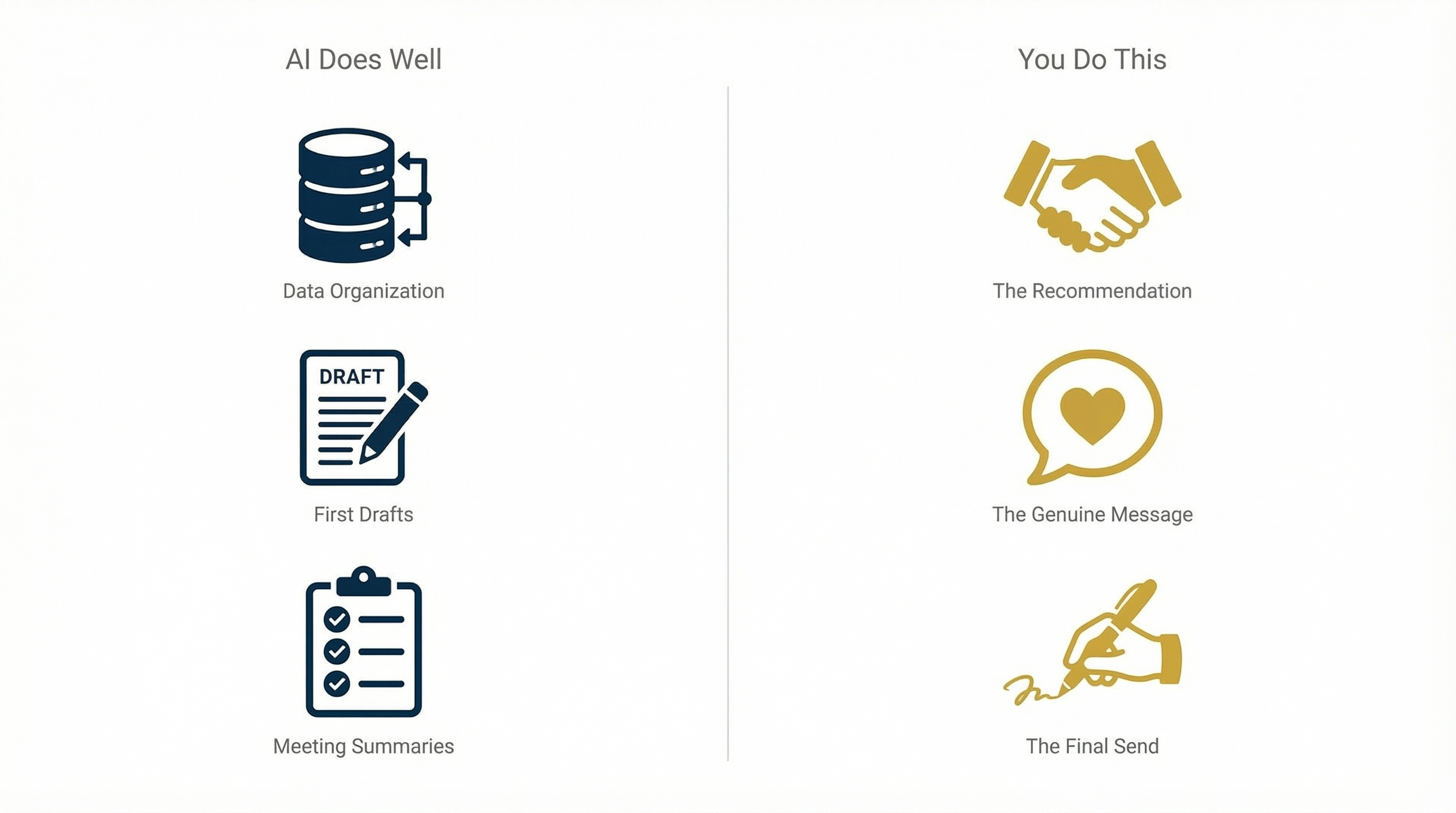
  • The Method: AI creates efficiency; You create empathy. Don't mix them up.

  • The Foundation: Structure must come before visibility. You cannot automate a mess.


future of collaboration

The Human vs. Machine Disconnect in Marketing

Many business owners feel caught in a difficult position. You see the promise of AI for efficiency, but you worry it will strip the soul from your marketing, at least that is what I hope you think.

The pressure is on to automate everything and push out more content faster. This creates a psychological trap, a belief that you must choose between smart technology and real human connection.

Here is the deal: That is the wrong way to look at the problem.

The issue is not about choosing between a human and a machine. The real problem is a broken marketing system. When your data is a mess and your tools do not communicate, you cannot effectively balance anything. You end up with robotic automation that feels cold or you burn out trying to manually connect with everyone.

Neither approach builds the trust you need to grow.

The goal is not to replace your voice with an algorithm. The goal is to build a system that allows your voice to be heard by the right people at the right time.

Human-centric marketing in an AI world starts here: Acknowledge that technology is a support system, not the main event. Your expertise, your story, and your ability to solve a customer’s problem are the core. AI can handle the repetitive logistics (organizing contacts, scheduling messages), which frees you to do what only you can do: build relationships.


ai content vs authentic brand voice

Why Your Unique Brand Voice Is Your Greatest Advantage

In a world where anyone can use generative AI to create content, your unique perspective has become more valuable than ever. The market is quickly filling with generic, algorithmic content that all sounds the same.

This creates a huge opportunity.

Relying on AI to create your core message is a path to becoming invisible. Your customers are not looking for perfectly polished, soulless text. They are looking for a guide they can trust, an expert with real experience who understands their problems.

To cut through the noise, you must lean into the things an algorithm cannot replicate:

  • Your Imperfections: Real is better than polished.

  • Your History: AI doesn't have an origin story; you do.

  • Your Opinions: Stand for something specific.

Ask yourself these questions to find your voice:

  • What is my core belief about this industry?

  • What is the common advice I completely disagree with?

AI can imitate, but it cannot originate a deeply held belief based on experience. Use AI to brainstorm ideas, structure an outline, or check for grammatical errors. But the final words, the core message, and the emotional tone must come from you.


Redefining Trust in the Age of AI

The conversation around trust and technology is changing. For a long time, it was about data privacy and security policies. While those are still important, a new, more personal layer of trust has emerged.

Your customers now want to know if the person they are communicating with is real.

Building emotional connections digitally is the new standard for credibility. In an environment where deepfakes and AI-generated content are common, people are naturally skeptical. They are looking for signs of genuine humanity.

This is where Radical Transparency becomes a powerful tool.

It means being honest about your processes and even your use of technology. It is not about hiding your tools but about showing how they help you serve your customers better.

The "Ethical AI" Approach: For example, you might explain to a client that you use an automation tool to ensure you respond to every inquiry quickly. You are not pretending each initial email is typed by hand; you are showing that you have a system in place to be reliable.

This proves you are a professional who can be counted on. That is a form of trust that no AI can fake.


three step content creation process

How to Maintain Authenticity While Using AI Tools

Many business owners are asking the same question: How do I use these powerful tools without losing my brand’s soul?

The answer lies in defining clear roles. You must treat AI as a capable assistant, not as the Creative Director of your business.

1. The "Human First" Draft Establish your own voice and message without any AI involvement. Before you open a tool, you should know what you want to say. Write down your core ideas, your stories, and your unique perspective. This human-generated material becomes the foundation.

2. Specific, Structured Tasks AI should only be used to build upon what you have already created. Don't ask AI to "write a blog about marketing." Instead, ask it to "help me outline five sections for a blog about why connected systems are more important than lead generation."

  • Use it for research (stats/supporting arguments).

  • Use it to generate headline options.

  • Use it to repurpose core content (turning a blog into social captions).

3. The "Editor-in-Chief" Review In this model, you always have the final say. You must review everything the AI produces and infuse it with your personality. Does it sound like you? Does it reflect your values? This final human review ensures your content remains genuinely yours.


connected system infrastructure diagram

The Infrastructure of Empathy (Building a Connected System)

The endless chase for more attention, more posts, more ads, more platforms. is exhausting and leads to burnout. The real path to sustainable growth is building a smart, connected system where technology works to support human connection.

You cannot build a relationship if you don't have your house in order.

1. Centralize Your Data (Organizational Memory) Before you worry about AI, organize your data. Your contacts, leads, and customers should not be scattered across spreadsheets and notebooks. They need to live in a central CRM. When your data is clean, you stop losing opportunities that were falling through the cracks.

2. Connect Your Tools (Context) Your website, email platform, and calendar must speak the same language. This creates a seamless experience. When someone downloads a resource, the system should automatically send a relevant follow-up. This is how you balance automation with empathy: The automation handles the task reliably, allowing you to focus on the quality of the message.

3. Automate the Logistics With a connected system, AI becomes truly useful. It can help you identify your most engaged leads so you can reach out personally. The system provides the structure, and the technology provides the efficiency.

The takeaway? Stop chasing attention and start building an ecosystem that attracts and nurtures the right clients through trust and reliability.


Frequently Asked Questions (FAQs)

Q. Can AI content ever be truly authentic? A. AI-generated content on its own lacks lived experiences and genuine beliefs, so it cannot be truly authentic. However, AI can be a tool used in an authentic process. When you use it to research, outline, or refine your original ideas, the final product is authentic because it is guided by your expertise.

Q. How do I start building a unique brand voice? A. Start by defining your core viewpoint. What do you believe about your industry that others might not? Document your origin story, your values, and the key lessons you have learned. This raw material is the foundation of a voice that cannot be replicated by an algorithm.

Q. Why does human connection matter more than ever in marketing? A. As AI makes it easier to produce generic content, genuine human connection has become a rare differentiator. People are overwhelmed with information and are looking for trusted guides. A real connection, built on empathy, creates the trust needed to choose you over a competitor using impersonal messaging.

Q. What is the first step to balancing automation and personalization? A. The first step is to organize your data. You cannot personalize communication effectively if you do not have clean, accessible information about your audience. Start by consolidating your contacts into a single CRM system to build the foundation for automated, relevant workflows.

Q. How can I be transparent about using AI without losing credibility? A. Frame your use of AI as a benefit to the customer. Be honest that you use technology to improve efficiency and reliability (like faster response times) so you can better serve them. This positions you as a strategic professional, which builds credibility rather than diminishing it.


trust foundation pyramid

The Foundation of Trust Is a System, Not a Tool

The debate over artificial intelligence in marketing often misses the point entirely.

Business owners are worried about sounding robotic or losing their authentic voice, while customers are simply trying to find someone they can trust to solve their problem.

Your audience does not care if you used AI to help outline a blog post. They care if the advice in that post is sound. They care if you are consistent, reliable, and empathetic to their needs. Trust is not built by a tool; it is built by a system that delivers a dependable experience every time.

Before you can effectively use any advanced technology, you must have a strong foundation. This means getting your internal house in order:

  • Organize your scattered data into a clear, connected system.

  • Link your marketing tools so they work together.

  • Create a seamless journey for your clients.

When you have this structure in place, tools like AI become powerful assets instead of potential threats. You can use them to enhance your well-defined, human-led process.

Stop chasing the next new tool. Stop worrying about whether you are falling behind on the latest trend. The path to building authority is about clarity, consistency, and connection. Real, sustainable growth happens when your foundation is strong enough to hold it.


See the System in Action

Don't just read about building trust, see how it works. Join our next live webinar on The Lift Marketing System to learn how to organize your data and automate your follow-up without losing the human touch. Register by clicking here.

Nathan Klug is an educator, founder, and operator who helps small businesses simplify their operations and turn existing contacts into real opportunities. As the creator of LIFT Growth Systems, he guides business owners away from marketing chaos and toward clear, sustainable growth.

Through his four core offerings, the LIFT Marketing System, Authentic Engagement Agent, Content Engine, and Authority Engine, Nathan provides a complete framework to start conversations, nurture relationships, and build lasting brand authority. He believes in systems over tactics and consistency over cleverness, helping leaders stop buying leads and start having authentic conversations with their ideal prospects.

With over 15 years of experience building teams and running marketing operations, Nathan is known for his calm, direct approach. He helps people see exactly what is happening inside their business and bridges the gap between scattered ideas and scalable execution.

Nathan Klug

Nathan Klug is an educator, founder, and operator who helps small businesses simplify their operations and turn existing contacts into real opportunities. As the creator of LIFT Growth Systems, he guides business owners away from marketing chaos and toward clear, sustainable growth. Through his four core offerings, the LIFT Marketing System, Authentic Engagement Agent, Content Engine, and Authority Engine, Nathan provides a complete framework to start conversations, nurture relationships, and build lasting brand authority. He believes in systems over tactics and consistency over cleverness, helping leaders stop buying leads and start having authentic conversations with their ideal prospects. With over 15 years of experience building teams and running marketing operations, Nathan is known for his calm, direct approach. He helps people see exactly what is happening inside their business and bridges the gap between scattered ideas and scalable execution.

LinkedIn logo icon
Instagram logo icon
Youtube logo icon
Back to Blog