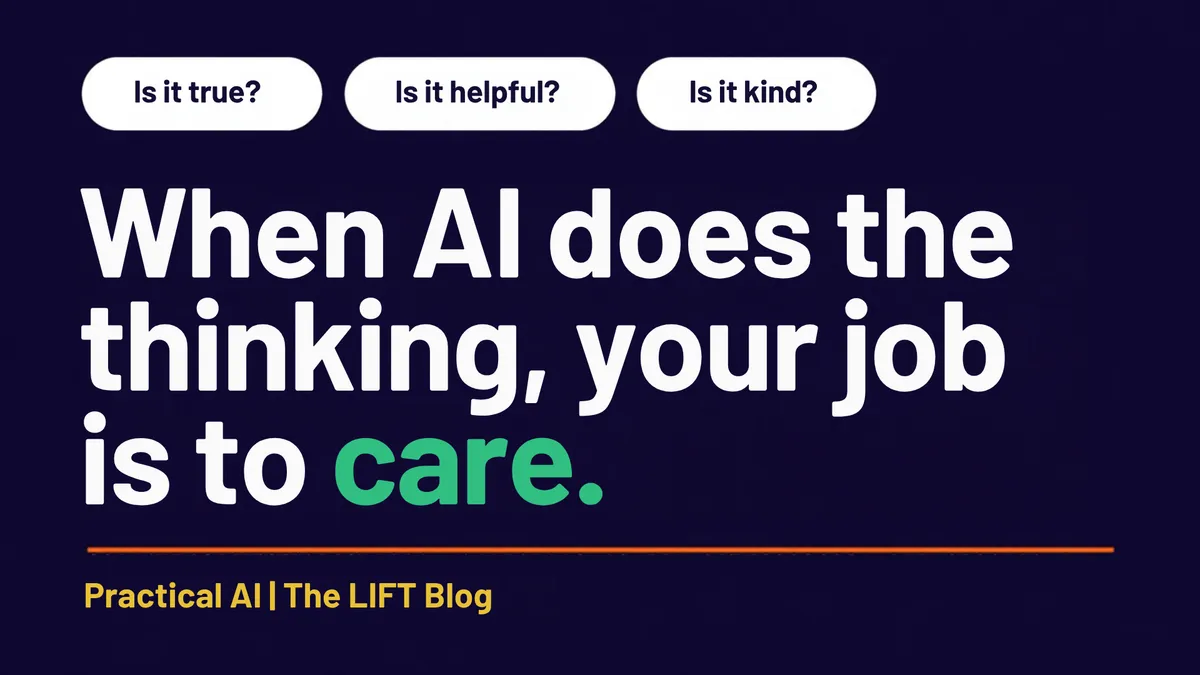
When AI Does the Thinking, Your Job Is to Care
In a world where AI can write a symphony, design a building, and draft a legal brief, it's no wonder business owners are asking a heavy question: What's left for me to do?
The ground is shifting. The old rules, where value was tied to efficiency and output, are being rewritten by algorithms. It's easy to feel like your expertise, your experience, and your very identity as a leader are becoming a commodity.
As AI becomes more capable, our value shifts from task-doer to strategic thinker.
But here's the thing: your value isn't disappearing, it's shifting. In this post, I'll show you how to move from being the 'engine' to the 'architect,' and how to use your human judgment as your most powerful asset in a world of AI. We'll explore how to build trust and create real human connection, not just more noise.
But the problem isn't that your value is disappearing. It's just shifting.
True business is built on relationships, a lesson that holds true even in a high-tech world.
I learned the value of human connection long before I ever touched a marketing system. Working in my parents' bakeries, I saw that business wasn't about transactions; it was about showing up and caring for people. It was about remembering a customer's name or asking about their family.
That lesson is the key to understanding this new world of AI and automation supporting human connection.
And the reality is simple. Your job is no longer to be the engine, doing the repetitive work. Your new job is to be the architect, using these powerful tools to build something meaningful. Technology is handling the processing, but you have to provide the purpose.
Key Insights
Your value is shifting, not disappearing. As AI handles repetitive tasks, your role evolves from being an "engine" to an "architect."
Human judgment is your most valuable asset. In a world of infinite content, your ability to filter, validate, and stand behind information is what builds trust.
We are entering a service-creation economy. Your ability to care, empathize, and solve unique human problems is the new currency.
Technology should enhance connection, not replace it. Use automation to free up time for more meaningful, authentic conversations.
The Shift From Engine to Architect
For a long time, professional value was tied to being a good "engine." Your job was to process information, follow a linear set of steps, and produce a predictable output. You were paid for your effort and your efficiency.
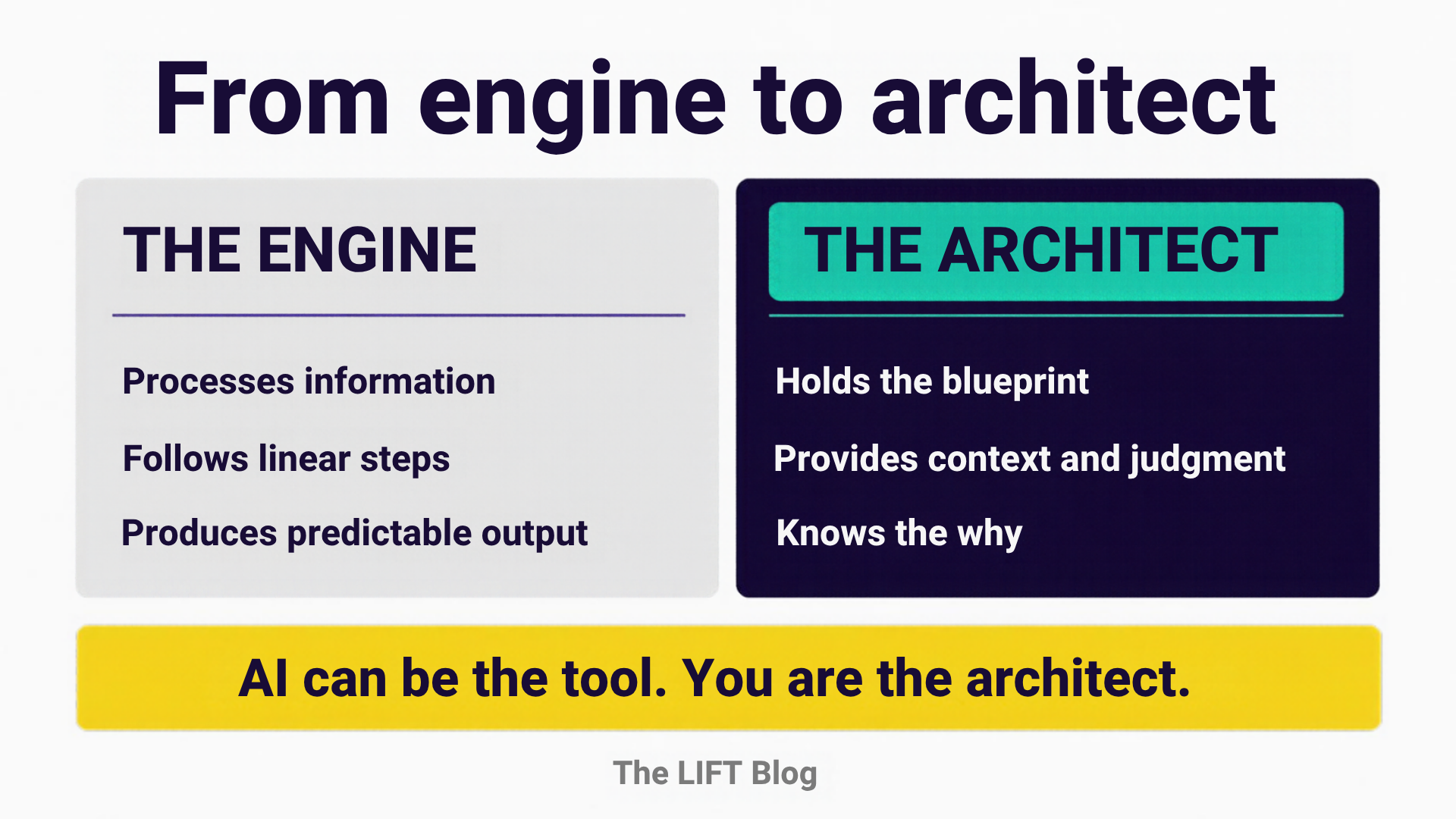
The choice is simple: compete with machines on efficiency, or embrace your uniquely human ability to be the architect.
But machines are just better engines. They can process more data, follow instructions perfectly, and work without getting tired. Trying to compete with them on that level is a losing game.
So you have to change your role from the engine to the architect.
Think of it like building a house. The engine is the power saw that cuts the wood. It's incredibly efficient at its one task. But the architect is the one who has the blueprint. The architect understands the family that will live there, knows why a window needs to face the morning sun, and decides where the walls should go to create a feeling of home. The saw has no understanding of "home." It only understands "cut."
AI can be the tool, but you must be the architect who provides the vision and the "why."
AI is changing the role of human workers by shifting their value from being an 'engine' that performs linear tasks to being an 'architect' who provides context, judgment, and purpose. As machines handle information processing, humans become essential for connecting ideas, ensuring accountability, and directing technology toward meaningful goals.
And this is where you find your new advantage. Your job is to provide the blueprint. You own the "why" behind the work. This is the strategic role of technology and automation: to free you from being the engine so you can spend all your time being a better architect.
Why Human Judgment is Your Most Valuable Asset
In a world where AI can generate a thousand blog posts in a minute, content itself is no longer scarce.
In an age of information overload, your judgment is the most valuable filter you can offer.
But what becomes incredibly rare, and therefore incredibly valuable, is human judgment. An algorithm can give you an answer, but it can't tell you if it's the right answer for a specific person in a specific situation.
And this creates a huge problem: the erosion of trust. When everything sounds the same, people stop trusting anything. There's a massive gap between how much companies think they're trusted and how much they actually are. A recent PwC survey found that while 90% of executives believe customers highly trust their companies, only 30% of customers actually do. Your job is to be the human filter that closes that gap.
This comes down to a simple system of accountability. An AI has no reputation to lose. It can't feel shame for giving bad advice. It has no "skin in the game." But you do. Your name is on the work. Your relationships are on the line. People don't just pay for information anymore. They pay for your judgment, your experience, and your willingness to stand behind your work. This is how you go about maintaining credibility and authenticity.
So before you use anything a machine creates, you have to run it through three simple questions:
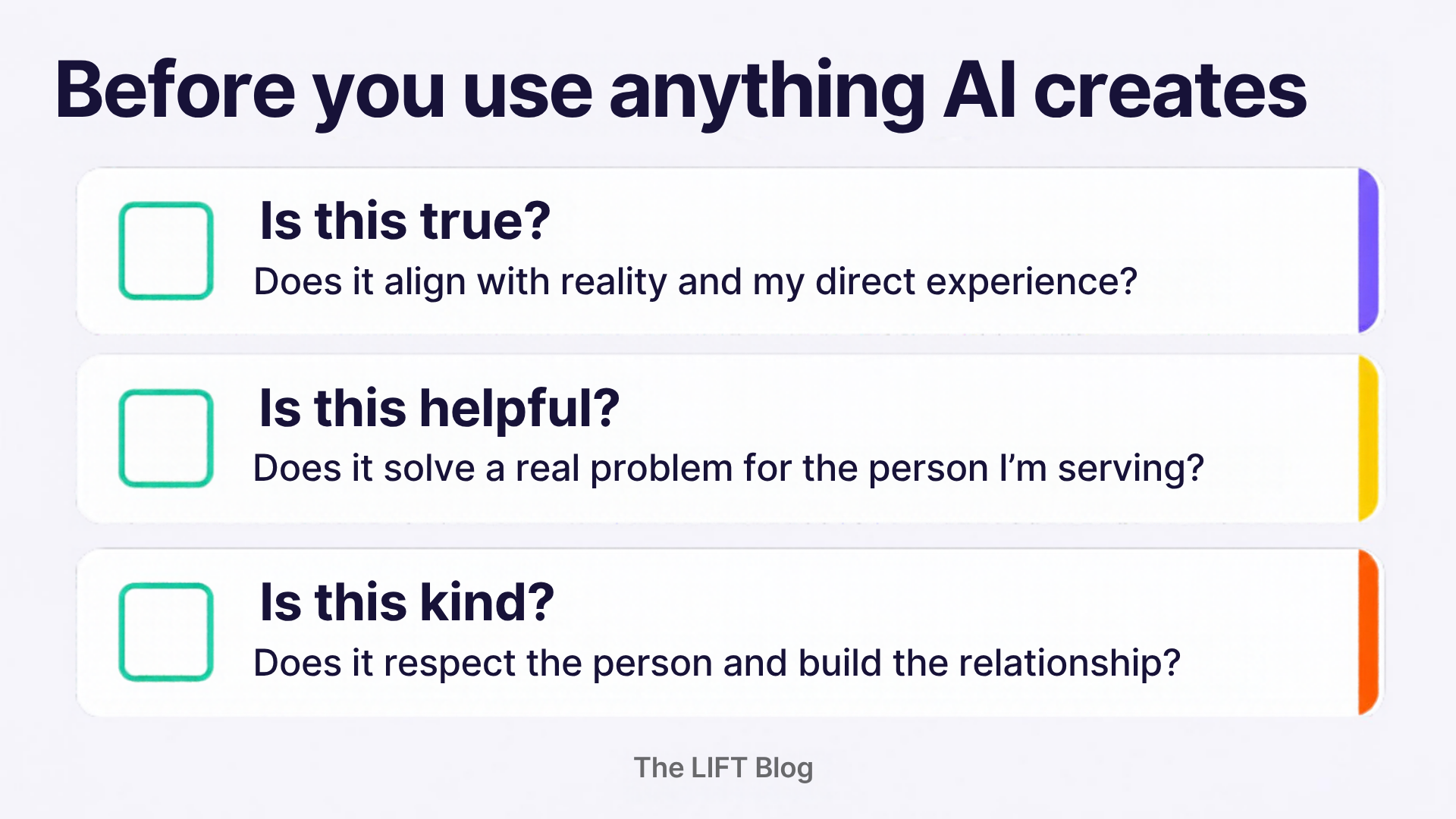
This simple three-question filter is what separates your work from that of a machine.
Is this true? Does it align with reality and my direct experience?
Is this helpful? Does this actually solve a real problem for the person I'm serving?
Is this kind? Does it respect the person on the other end and build the relationship?
And that's it. Your ability to ask and answer those questions is what separates you from the machine. It's the most valuable service you can offer.
The Future is the Service-Creation Economy
We are moving away from an economy where you are paid for your time or your labor. We are entering a service-creation economy, where you are paid for the tangible impact you create for another human being.
The new economy values human connection and tangible impact over mere labor.
Your ability to care, to understand, to empathize, and to solve a unique problem is the new currency.
In this model, what used to be called "soft skills" are now the highest-paid skills. They are the things a machine cannot replicate. Trust as Core Infrastructure is the foundation of this entire system. Without it, no transaction happens, no relationship is built, and no value is created.
So what does this new economy value most?
Human Insight: The ability to see the connection between two unrelated ideas that a machine would miss.
Empathy: The ability to truly understand the emotional context of a client's problem, not just the technical details.
Accountability: The willingness to take personal responsibility for the outcome.
Courage: The willingness to tell someone the truth, even when it's not what they want to hear.
And this is the core of it all. The machine provides the processing power. But you provide the purpose, the care, and the connection. The machine can write an email, but you are the one who knows if it's the right email to send to that specific person at that specific time.
Frequently Asked Questions
1. What might an automation paradox be?
The automation paradox highlights that technology makes human judgment more, not less, essential.
And the automation paradox is simple: the more tasks we automate, the more valuable the remaining human tasks become. When machines handle routine work, skills like critical thinking, emotional intelligence, and creative problem-solving become the primary drivers of value. The paradox is that technology makes human judgment more, not less, essential.
2. What is the major difference between trust and automation use dependence?
So, dependence on automation is about efficiency. You use a tool because it's fast and reliable for a specific task. But trust is about relationship and risk. You trust a person because of their character, judgment, and past actions, especially when the outcome is uncertain. You depend on a calculator, but you trust an advisor.
3. How do you build trust professionally?
Trust is built through a thousand small, reliable actions that show you care.
You build professional trust through a simple, repeatable system: say what you will do, do what you said you would do, and be honest when things go wrong. It's about consistency over time. Trust isn't built in one big moment. It's built in a thousand small, reliable actions that show you care about the outcome for the other person.
4. How can AI support authentic human connection instead of replacing it?
AI can support connection by handling the tasks that get in the way of it. For example, it can schedule meetings, transcribe notes, and summarize long email chains. This frees up your time and mental energy to be fully present in conversations, listen deeply, and focus on understanding the other person's needs instead of just managing logistics.
Your Purpose in a World of AI
So here's the thing. The fear that AI will take your job is based on the old rules, where your job was to be an efficient machine.
But the game has changed. Your job is not to work harder than the machine. Your job is to care more.
Your value now comes from three places. First, from being the architect, not the engine. Second, from applying your human judgment as a filter. And third, from creating real impact for other people in a service-creation economy.
Ready to build a system that creates real conversations? Let's connect.
And the reality is simple: technology should help you talk to more people, not fewer. Your greatest opportunity isn't in finding a better algorithm; it's in building a better system for human connection.