Who Owns the Callback When You're Out?
Who owns the callback at your business? If the answer is "whoever sees it first" or "me, eventually," nobody owns it, and that's where customers go missing. The fix takes about ten minutes. List every way a customer can reach you, put one person's name and one backup on each, and decide how fast a reply goes out.
What does "who owns the callback" mean?
It means one named person is responsible for the next conversation with a customer who reached out. One person, with a backup for the days they're out. "The office" and "the team" aren't names.
A missed callback looks like an effort problem. Someone was busy, the phone rang during a job, somebody forgot. Often the cause is simpler. Three people heard about the call, and each one assumed another one had it.
Picture a four-person roofing company. The office line forwards to the owner's cell after 3 PM. The office manager checks voicemail at lunch. The crew lead hands out his own number on job sites. The web form emails an inbox the owner set up years ago. A homeowner calls Monday about a leak, and on Thursday everyone is surprised that nobody called her back.
An insurance agency has its own version. A client emails about adding a teenage driver. The producer thinks the service rep has it, and the service rep thinks the producer is quoting it. The next conversation starts with an apology.
Both are composites, not real clients.
Why do callbacks fall between people?
It usually comes down to three things.
The first is the shared door. A main line, a shared inbox, a Facebook page anyone can answer. Shared doors are convenient, and they let everyone assume someone else walked through.
The second is the owner as the default backup for everything. When nobody else is named, the call goes to the owner, which works until the owner is on a roof, at a closing, or on vacation.
The third is no definition of done. "I left a message" feels finished to the person who called. To the customer, nothing has happened yet.
I learned the cost of the second one early. When I co-founded Paradigm Financial Associates, we brought on 100 agents in 90 days. I was the main trainer, and my knowledge became the bottleneck, because there was no system to develop anyone else to do what I did. Good relationships and long hours didn't solve it. That lesson is where my whole approach to building systems started.
How do you give every callback an owner?
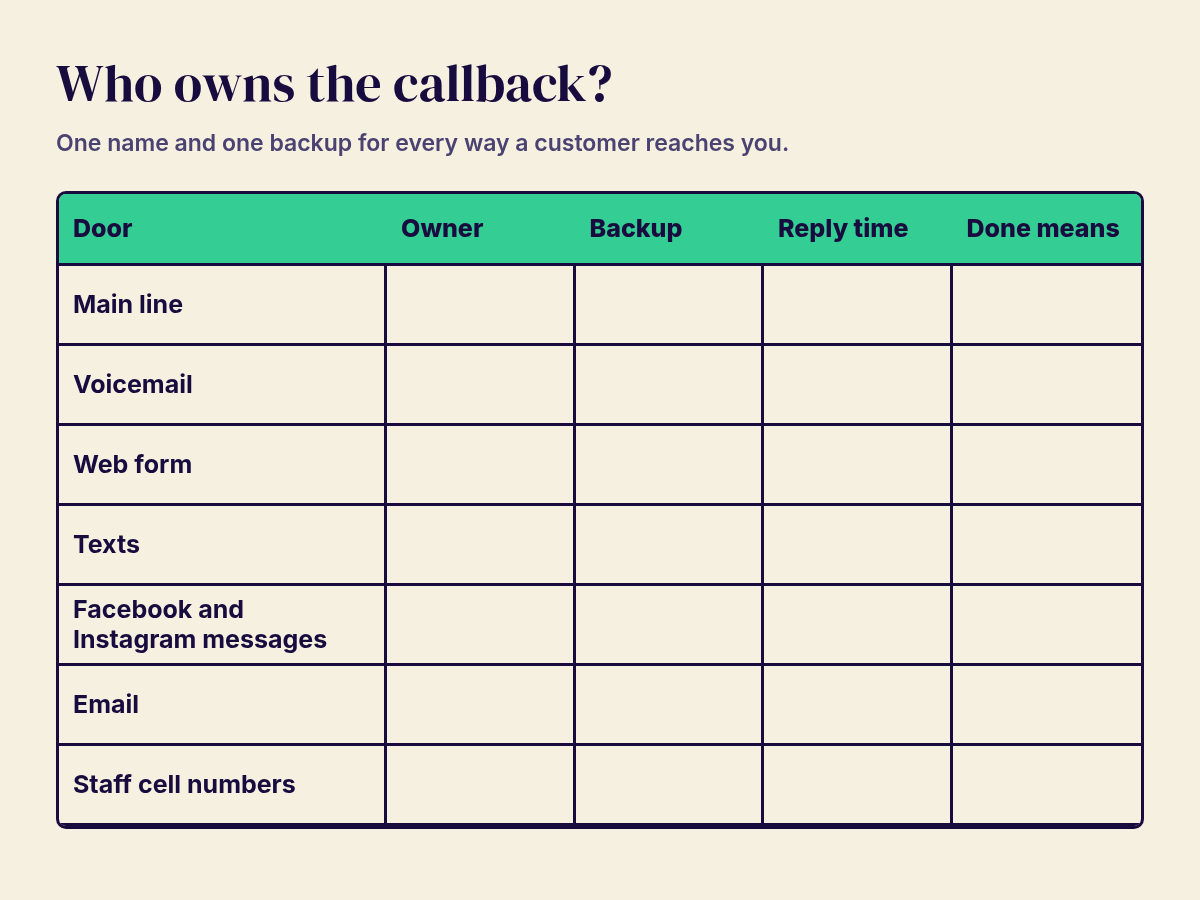
Grab a sheet of paper or a blank spreadsheet and make five columns. Door, owner, backup, reply time, and what done means.
-
List every door. Write down every way a customer can reach you today. The main line, voicemail, the web form, text messages, Facebook and Instagram messages, email, and any employee who gives out a personal cell number. Include the ones you'd rather not count.
-
Put one name on each door. A person's name. Two names on one door tends to mean nobody.
-
Add a backup and a reply time you can keep. Who covers when that person is sick, on vacation, or out on a job all day? Pick a reply time you can hit every week, including the busy ones.
-
Decide what done means. For most service businesses, done means the customer has an answer, a time on the calendar, or a clear next step. Phone tag doesn't count.
-
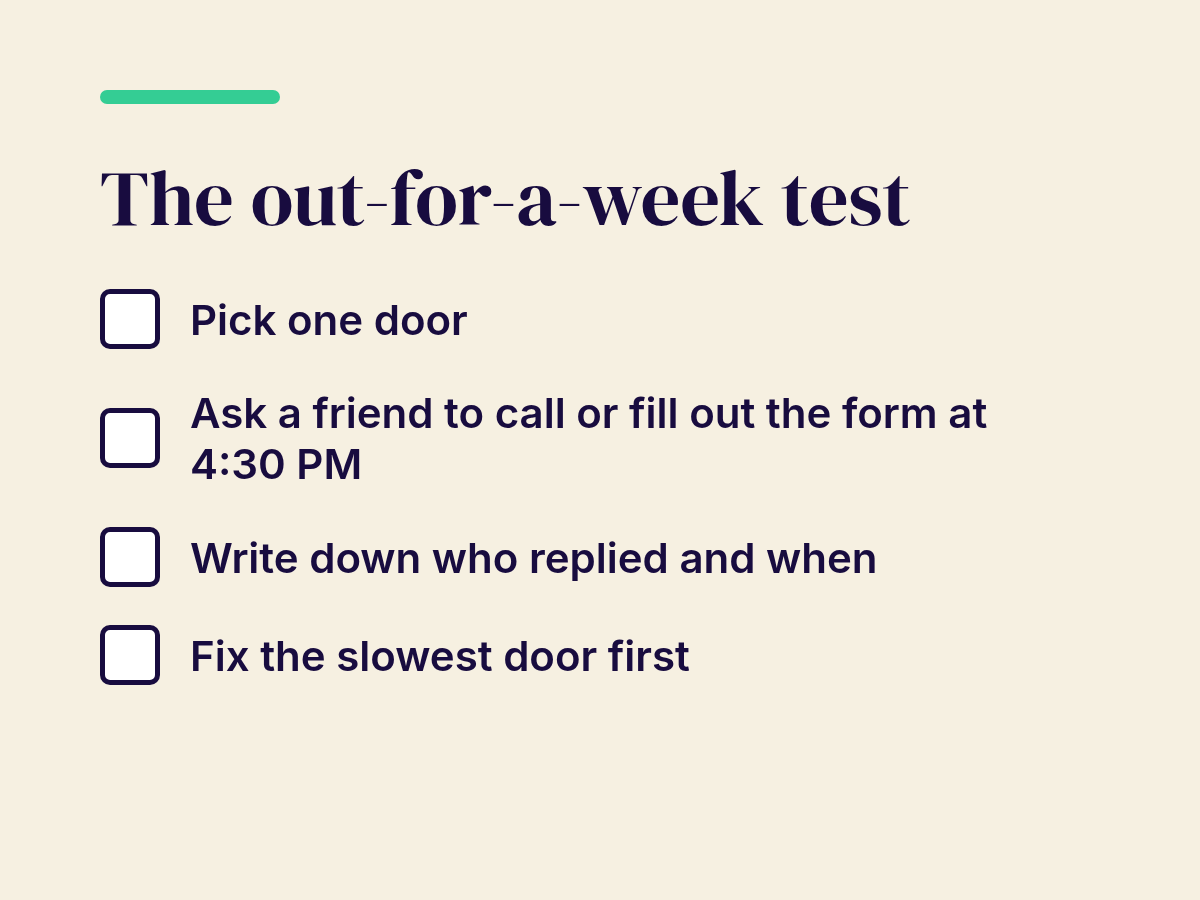
Before Friday, run the out-for-a-week test. Pick one door. Ask a friend to leave a voicemail or fill out your form at 4:30 PM on a weekday, then watch who replies and how long it takes. Do it on a day you're out of the office if you can.
Then look at the names. Every line with yours on it is a conversation that waits when you're out.
How fast does a callback need to happen?
Sooner than a lot of businesses manage. In a study published in Harvard Business Review in 2011, researchers sent a test web lead to 2,241 US companies. 37% responded within an hour, and 23% never responded at all.
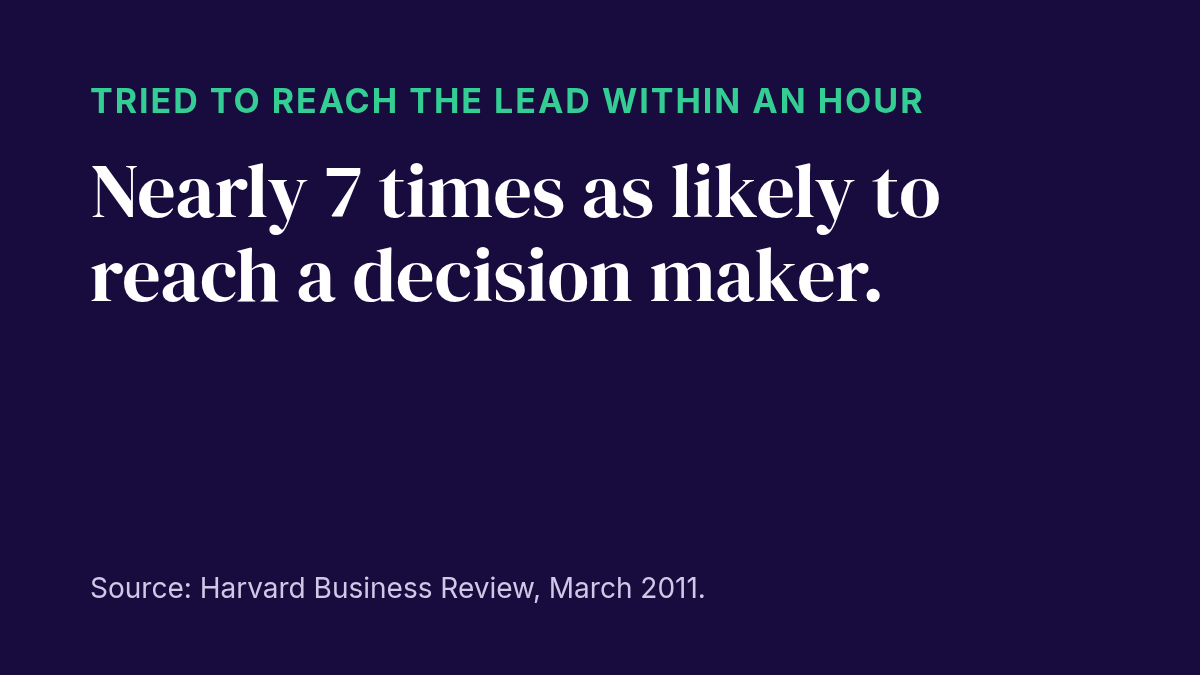
In a separate set of 1.25 million leads, companies that tried to reach a lead within an hour were nearly seven times as likely to have a meaningful conversation with a decision maker as companies that tried even an hour later.
The study is old, and it measured web leads, so your trade's numbers won't match. The direction is hard to argue with. A reply in the first hour usually does more than a better reply tomorrow. If you've read why more leads won't fix a dropped callback, this is the same problem from the other side.
Where do tools fit?
After the names are on the sheet. A CRM can assign a conversation to a person, remind them, and show you which ones are still open. A missed-call text can tell the customer you got the call. An AI receptionist can answer after hours and book a time.
Each of those hands the conversation to someone. With no owner, the tool moves the dropped call to a new place.
Can voice AI answer the calls nobody owns?
Often, yes, and it's a realistic option for a small business today. Voice AI is a phone assistant that answers in a natural voice when nobody on your team can pick up. It can answer common questions, take down what the customer needs, book a time on your calendar, and pass the conversation to the person whose name is on your sheet.
It fits best on the doors that drop the most calls. After hours, over lunch, the hour you're on a roof or at a closing, and the overflow when two calls come in at once.
It still needs an owner. Decide what it may answer and book, who gets the handoff, and how fast that person follows through. A voice assistant that books a time nobody keeps is a new way to miss the callback.
We include Voice AI, along with a chat widget and Conversation AI, in Lift Clarity, and we can help you set it up around the names on your sheet.
Start with the door that drops the most conversations. Name its owner, and then ask what would help that person. The Friction Audit is a good next step for finding the spots where customers give up, and your first sequence of messages after an inquiry covers what to send once someone owns the reply.
FAQ
What if I'm the only person in the business?
You own every door, so the backup question matters more. Decide what happens on the days you can't answer. That might be a voicemail greeting that says when you'll call back, a text reply, or a trusted person who can take a message and book a time.
Should the owner's cell number be on the website?
It gives customers the fastest callback there is, and it makes you the front desk at all hours. If you list it, give it a backup and set reply hours you'll keep.
How often should we update the sheet?
Whenever someone joins, leaves or changes roles, and before any time off longer than a couple of days.
One question before you go
Looking at your sheet, which door would go unanswered if you were out next week?
Every Friday I send The LIFT Signal, a short letter with one growth gap, one action, one tool decision and one question for owners of small service businesses. [Subscribe link: placeholder until the signup page is live]
If you'd like an outside look at what to fix first, Lift Clarity starts with a 90-minute strategy session and ends with a 90-day plan built around one or two changes. clarity.liftgrowthsystems.com
About the author: Nathan Klug runs LIFT Growth Systems. He helps owners of small home and professional service businesses build the systems behind their growth, after years of building agent organizations in insurance and financial services.